
SNDK Stock: SanDisk's AI Memory Surge and 2026 Outlook




SNDK stock has been the single loudest trade of 2026. SanDisk, spun out of Western Digital in February 2025, went from a forgotten flash-memory business into one of the S&P 500's best performers — up roughly 635% year-to-date and briefly worth more than four times its January price. This guide explains what SanDisk actually does, why SNDK stock exploded, what the earnings and forecasts say, where the real risks sit, and the practical ways to get exposure.
SNDK Stock at a Glance
SanDisk trades on the Nasdaq under the ticker SNDK. It designs and sells NAND flash memory and storage — SSDs, memory cards, and enterprise storage — the same technology now caught in the AI-driven memory shortage. The numbers below move fast, so always check a live quote before acting.
| Item | Detail (as of July 8, 2026) |
|---|---|
| Ticker / exchange | SNDK on Nasdaq |
| Recent price | ~$1,580 (after a 7.3% single-day drop) |
| 52-week / all-time closing high | $2,335.00 (June 25, 2026) |
| Year-to-date move | ~+635% |
| Trailing P/E | ~58 |
| Spin-off from Western Digital | Completed February 2025 |
| Core business | NAND flash, SSDs, enterprise & consumer storage |
Why SanDisk Stock Went Vertical in 2026
The whole story is memory pricing. Through 2024 and early 2025, NAND flash was a glut-ridden, low-margin commodity, and SanDisk traded like one. That flipped in 2026 as AI data centers began consuming storage and high-bandwidth memory (HBM) faster than the industry could supply it.
Two forces compounded. First, demand: training and serving large AI models needs enormous amounts of fast storage alongside compute. Second, supply discipline: major manufacturers have been converting existing NAND lines to compute-oriented HBM, which carries fatter margins. That diverted capacity — analysts estimate NAND production capacity could fall about 40% by 2027 versus the 2022 peak — turned a commodity into a scarce good almost overnight. NAND contract prices were guided up roughly 70–75% sequentially for calendar Q2 2026.
For a pure-play NAND supplier like SanDisk, that price move drops almost straight to the bottom line. The result was one of the sharpest re-ratings in the semiconductor space in years.
SNDK Stock Price Today: From Spin-Off to $2,335
SanDisk began independent life in early 2025 as an unloved spin-off. By June 25, 2026, SNDK stock closed at an all-time high of $2,335, before a broad memory-sector selloff — dragging down Micron, Western Digital, Seagate, Samsung, and SK Hynix — pulled it back toward the $1,500–$1,600 zone. On July 8, 2026, the stock fell 7.3% on profit-taking to around $1,580.
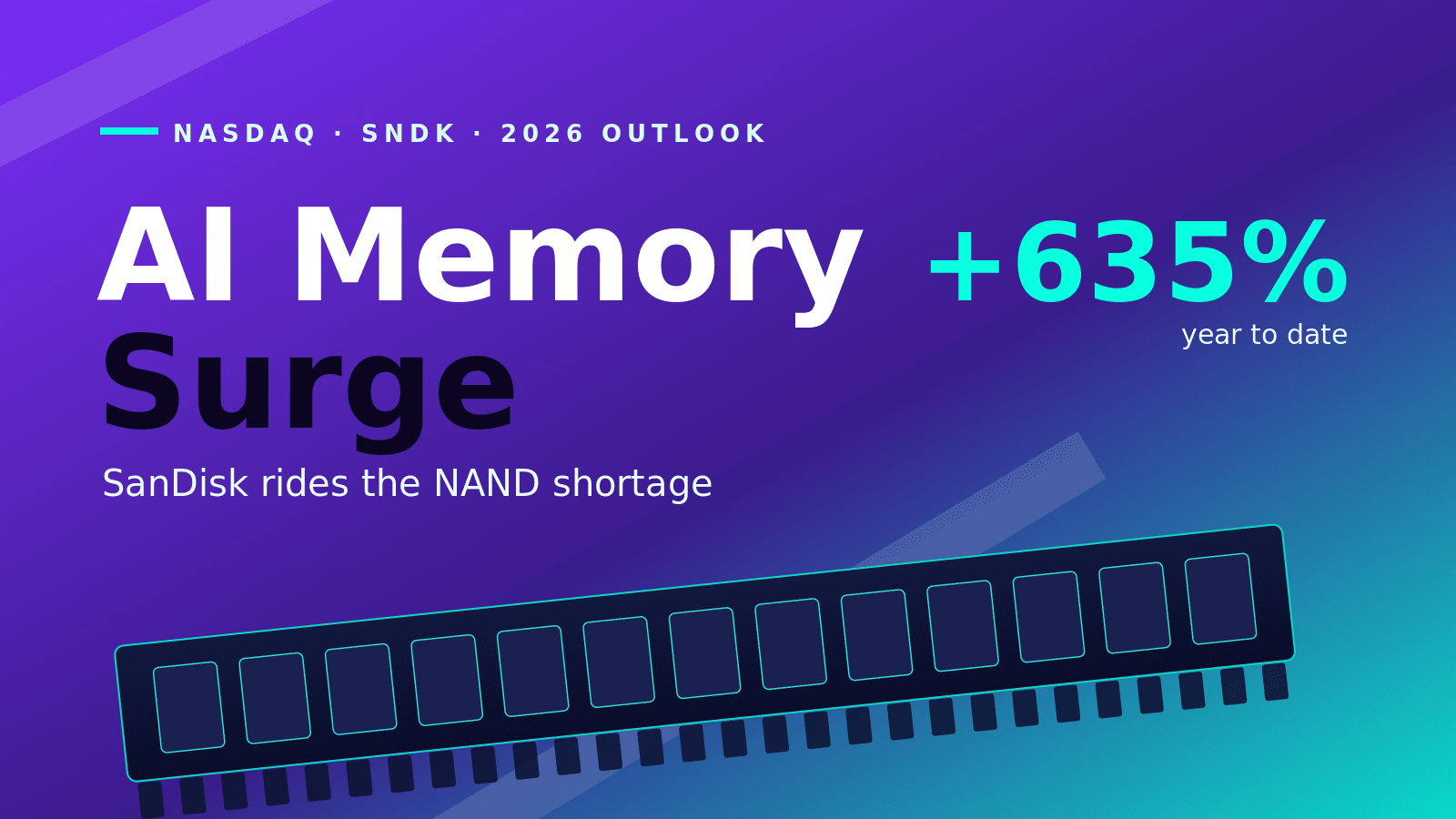
The takeaway is that SNDK is now a high-beta AI proxy, not a sleepy storage stock. Daily swings of 7–10% have become normal. Anyone treating it like a steady blue chip is mispricing the volatility.
SNDK Earnings: The Numbers Behind the Rally
The rally is not purely sentiment — the fundamentals inflected hard. SanDisk swung from a loss to large profits in a single year as memory prices climbed.
| Metric | Latest reported / guided | Year-ago comparison |
|---|---|---|
| Q3 FY2026 revenue | $5.95 billion | +251% year-over-year |
| Q3 FY2026 EPS (non-GAAP) | $24.43 | vs. −$13.33 loss a year earlier |
| Q4 FY2026 revenue guidance | $7.75–8.25 billion | Sequential step-up |
| Q4 FY2026 EPS guidance (non-GAAP) | $30–33 | — |
Swinging from a $13 per-share loss to a $24 per-share profit in twelve months is the kind of operating leverage that only shows up in memory once a cycle. It is also exactly why the stock is so dangerous in both directions: the same leverage works in reverse when prices roll over.
SNDK Stock Forecast: What Analysts Expect
Wall Street is broadly bullish but wildly dispersed on price. Coverage skews to buy ratings — TipRanks shows roughly 14 buys, 2 holds, and no sells, while MarketBeat tallies 18 buys, 3 holds, and 1 sell — yet the price targets range from below the current price to multiples of it.
| Scenario | 12-month reference level | Read |
|---|---|---|
| Bear | ~$1,000–$1,200 | Memory prices peak and roll over into 2027 oversupply |
| Base / consensus | ~$1,600–$2,040 | Cycle stays tight through 2026, earnings hold |
| Bull | ~$2,400–$3,250 | Sustained AI storage shortage; Bernstein-style targets |
| Long-shot | ~$5,000 (2-year) | A Motley Fool projection assuming a multi-year supercycle |
Treat the extreme targets as narrative markers, not base cases. The honest reading: consensus roughly brackets where the stock already trades, which means the market has largely priced in the good news. The upside from here depends on the cycle lasting longer than skeptics expect.
Is SanDisk Stock a Good Buy or Overvalued?
This is the real question, and it has no clean answer. The bull case is that a trailing P/E near 58 looks reasonable — even cheap — if you use through-cycle or forward earnings, because guidance implies EPS is still climbing fast. On that math, SNDK is not expensive for its growth.
The bear case is structural, and it deserves respect. Memory is one of the most cyclical industries in all of technology, prone to violent oversupply whenever manufacturers add capacity at the same time. Three specific risks stand out:
- 2027 oversupply. New NAND capacity tends to arrive late in a cycle. If the AI-storage shortage eases, spot prices fall and the roughly 40% of output that is uncontracted re-rates hard — the path to that $1,000–$1,200 bear zone.
- Valuation compression. A P/E near 58 leaves no cushion. Multiple compression alone could halve the stock even if earnings stay flat.
- AI capex normalization. Hyperscaler AI spending is expected to peak around 2026 and taper after. Less capex means less of the pricing power now driving SanDisk's margins.
The more important point for anyone buying today: you are not really buying SanDisk the company, you are buying a view on how long the memory cycle stays tight. That is a legitimate bet, but it is a cyclical timing bet dressed up as a growth story.
How to Buy or Trade SanDisk Stock
There are three realistic routes, and they suit different people.
| Route | Who it fits | Main friction |
|---|---|---|
| Buy SNDK through a broker | Anyone with US-equity access | Volatility; regional access limits |
| Tokenized / synthetic SNDK exposure | Non-US or crypto-native traders | No share ownership; tracking error |
| Stablecoin-settled stock products | Users holding USDT, no brokerage | Leverage and liquidation risk |
The cleanest route is direct: open a brokerage that lists Nasdaq stocks, search SNDK, and place a market or limit order, often in fractional shares. You get real ownership and any shareholder rights.
The other routes exist because much of the global market still can't easily buy US equities — regional rules, KYC friction, or slow fiat funding get in the way. To fill that gap, crypto exchanges increasingly list US stocks as stablecoin-settled or tokenized products that track the price 24/7. If that path is new to you, WEEX's explainer on tokenized US stocks covers how the custody and settlement plumbing actually works, and WEEX's TradFi markets let users hold USDT-based exposure to stocks, indices, and commodities in one account. For a worked example of trading a hot listing through crypto rails, see WEEX's guide on how to buy and trade SpaceX stock (SPCX).
Be clear about the trade-off: synthetic and tokenized products give price exposure only. You do not own SanDisk shares, you get no voting rights, and you receive no dividends.
Bottom Line
SNDK stock is the memory cycle in its purest form: a spin-off that no one wanted in 2025 became one of 2026's biggest winners because AI turned NAND flash from a commodity into a scarce input. The earnings are real and the analyst consensus is bullish, but the stock already prices in a lot of good news, and the same operating leverage that drove it up will drive it down when memory prices peak. Decide in advance what part of the cycle you are betting on, size accordingly, and if you want price exposure without a traditional brokerage, you can explore stock and TradFi markets on WEEX.
FAQ
1. What is SNDK stock?
SNDK is the Nasdaq ticker for SanDisk Corporation, a maker of NAND flash memory, SSDs, and storage products. It became a standalone public company after spinning off from Western Digital in February 2025.
2. Why is SanDisk stock up so much in 2026?
AI data centers drove a shortage in NAND flash and high-bandwidth memory. As manufacturers shifted capacity toward HBM, NAND supply tightened and contract prices jumped roughly 70–75% in calendar Q2 2026, sending SanDisk's earnings — and SNDK stock — sharply higher.
3. What is the SNDK stock forecast for 2026?
Analyst targets are widely dispersed, roughly from a $1,000–$1,200 bear case to $2,400–$3,250 bull targets, with consensus clustered near where the stock already trades. One long-range projection floated $5,000 over two years, but that assumes a sustained supercycle.
4. Is SanDisk stock overvalued?
At a trailing P/E near 58 the stock leaves little room for error. Bulls argue forward earnings make it cheaper than it looks; bears note that memory is deeply cyclical and that valuation compression plus a 2027 oversupply could halve the stock.
5. How can I buy SNDK stock?
Through any brokerage that lists Nasdaq stocks, using a market or limit order, often with fractional shares. Traders who can't access US equities sometimes use tokenized or stablecoin-settled stock products on crypto exchanges, which track the price but confer no share ownership.
Risk Warning
SNDK stock is a high-volatility, deeply cyclical asset, and it can fall as fast as it rose. SanDisk's earnings are tied to NAND memory pricing, which historically swings through boom-and-bust cycles; a shift to oversupply in 2027, a normalization of AI capex, or new low-cost competition could compress both earnings and the valuation multiple at the same time. The stock has already recorded single-day moves of 7% or more. Tokenized, synthetic, and stablecoin-settled stock products carry additional risks — leverage and forced liquidation, funding costs, tracking error against the real share price, counterparty risk, and no shareholder rights or dividends — and are unavailable to US persons on most venues. Never invest money you cannot afford to lose, and confirm eligibility in your region before trading.
Disclaimer: This content is provided for general informational and educational purposes only and should not be considered financial, investment, legal, or tax advice. Nothing in this article constitutes an offer, recommendation, solicitation, or invitation to buy, sell, or trade any crypto asset or use any specific service. Crypto assets are highly volatile and involve a high degree of risk. You may lose some or all of the value of your investment and should not invest funds you cannot afford to lose. WEEX services may not be available in all regions and are subject to applicable laws, regulations, and user eligibility requirements. Please carefully assess risks and confirm local requirements before making any financial decisions.