
How Prediction Market Works?A Complete Guide to Pricing and Mechanisms

Prediction markets are built around a simple idea: people express what they think will happen in the future by trading contracts tied to real-world outcomes. Instead of focusing on asset value, the system reflects probability, where prices move based on how participants interpret new information as it appears.
In recent years, platforms like Polymarket have made this model more visible by allowing users to trade on events such as elections, economic data, and crypto market movements. As more participants enter these systems, prediction markets begin to show how collective expectations form and shift in real time.

What is a Prediction Market?
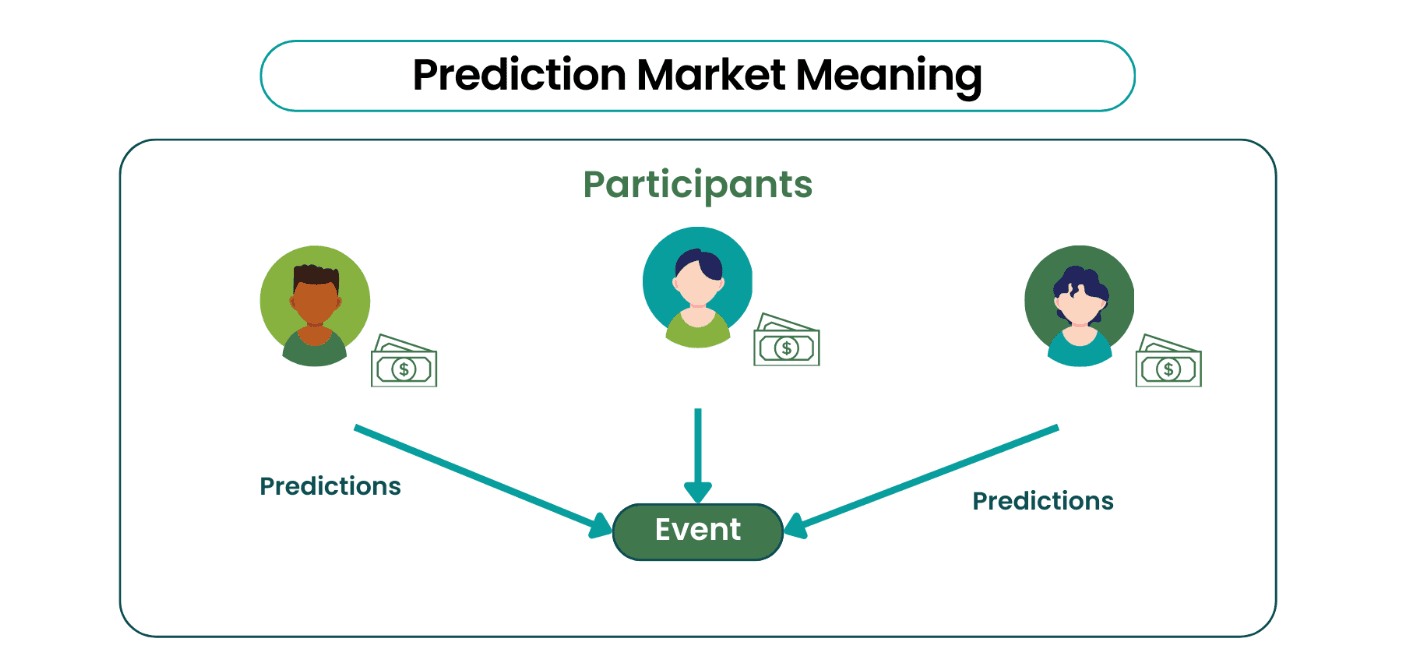
Prediction market is a system where users trade contracts based on the outcome of future events. These events can include political elections, economic indicators, financial markets, crypto trends, or global developments.
Unlike traditional markets, prediction market does not focus on asset value. Instead, it focuses on probability. Each contract represents whether a specific outcome will happen.
If the event occurs, the contract settles at a fixed value. If it does not, it expires worthless. This simple structure allows prediction market systems to convert opinions into pricing.
How Prediction Market Works in Practice?
Prediction market works by allowing participants to buy and sell event-based contracts. Prices move based on supply and demand, reflecting the changing probability of an event.
A contract priced at 0.70 means the market assigns a 70% chance of that outcome happening.
When new information enters the system, traders adjust their positions. Some react immediately, while others wait for confirmation before acting. These differences create continuous price movement.
Over time, prediction market pricing becomes a reflection of collective expectations rather than individual forecasts.
Why Prediction Market Matters?
Prediction market matters because it transforms opinions into measurable signals.
Instead of relying on static forecasts or delayed reports, prediction market systems react in real time to new information.
This makes them useful for understanding expectations around financial markets, political events, economic data, and broader global developments.
As participation increases, prediction market signals often become more refined and responsive.
Prediction Market as an Information Layer
Prediction market functions as a live information layer where thousands of individual judgments are combined into one price signal.
Rather than relying on a single authority or model, prediction market aggregates distributed knowledge across participants.
However, accuracy depends on participation and liquidity. More active markets tend to produce more stable and reliable probability signals.

How Polymarket Fits Into Prediction Market Systems?
Polymarket is one of the most widely recognized platforms in the prediction market space.
It allows users to trade on real-world outcomes such as elections, inflation data, crypto trends, and geopolitical events.
Unlike traditional financial platforms, Polymarket focuses entirely on outcomes rather than asset ownership.
Its growth has helped bring prediction market concepts into mainstream discussions, especially within crypto and digital asset communities.
Polymarket and Real-Time Market Behavior
Polymarket is often used as a reference point for how prediction market systems behave under real conditions.
When new information appears, prices adjust quickly as traders reposition based on updated expectations.
In many cases, Polymarket reflects shifts in sentiment faster than traditional media coverage, since participants respond directly to information flow.
This makes it a useful example of how prediction market logic works in practice.

How Participants Behave in Prediction Market Systems
Prediction market behavior is shaped by how participants process information and respond to changing conditions.
When new events appear, some participants act quickly based on initial interpretation, while others take more time to reassess before making decisions. This difference in timing can lead to short-term price fluctuations.
Trading decisions are also influenced by how individuals evaluate uncertainty and decide how much risk they are willing to take in a given situation. As a result, market activity can shift depending on overall confidence levels.
Limitations of Prediction Market Systems
Despite its strengths, prediction market is not without limitations.
Some markets suffer from low participation, which can reduce accuracy. Others may experience short-term distortions caused by speculative trading.
Regulatory differences across regions can also affect how prediction market platforms operate.
Because of this, prediction market results should always be interpreted as probabilities rather than certainties.
Future of Prediction Market
The future of prediction market is closely linked to how global information systems evolve.
As more participants join prediction market platforms, pricing becomes more efficient and representative of collective expectations.
Blockchain infrastructure may further improve transparency and settlement reliability.
Platforms like Polymarket suggest that prediction market systems may continue expanding into mainstream decision-making environments.
Over time, prediction market could become a standard layer for understanding uncertainty in both financial and non-financial contexts.
Conclusion
Prediction market represents a shift in how information is priced and interpreted.
Instead of relying on static forecasts, prediction market systems continuously update based on collective behavior and real incentives.
Polymarket has played an important role in demonstrating how prediction market works in real environments.
As adoption grows, prediction market is likely to become a more important tool for understanding expectations and future outcomes across global markets.
FAQ
1. What is a prediction market?
A prediction market is a system where users trade contracts based on future outcomes.
2. How does prediction market work?
It works by pricing probabilities through buying and selling event-based contracts.
3. Why is Polymarket important?
Polymarket is one of the most well-known platforms that shows how prediction market works in real-world events.
4. Can prediction market be accurate?
It can be accurate when liquidity is strong and participants are well-informed, but it should still be treated as probabilistic.
5. What affects prediction market prices?
Prices are affected by new information, participation levels, and liquidity conditions
You may also like

Futu drop 40% After Crackdown: WEEX vs Traditional Brokers Guide
The Futu crackdown has triggered major changes in cross-border investing. This article explores the impact of the Futu crackdown, the rise of alternative platforms, and how WEEX compares with traditional brokers while offering a zero-fee deposit model to reduce trading costs.

What is Virl.fun (VIRL) Coin?
Virl.fun (VIRL) is an innovative token recently listed on the WEEX exchange. This highly anticipated listing allows users…

Federal Oil Reserve Stock: FOR Crypto Reality Check
Federal oil reserve stock explained: what FOR crypto is, why it is not official oil-backed equity, and what to check before trading.

Northern Oil Asset Reserve: What NOAR Traders Should Know
Northern Oil Asset Reserve, or NOAR, is a Solana token using oil-reserve branding. Here is what it is, what is unverified, and the key risks.

TUFT Token Price: How to Check and Buy TUFT Safely
Check TUFT token price, contract details, buying steps on BNB Smart Chain, and the liquidity, slippage, and fake-token risks to review before trading.

What Is OFDR? Official FIFA Defense Reserve Explained
OFDR is a Solana meme coin using Official FIFA Defense Reserve branding. Learn what it is, whether it is linked to FIFA, and the main trading risks.
The Futu Crackdown 2026: What It Means for Cross Border Investors?
Futu’s regulatory crackdown triggered a sharp selloff across cross-border brokers in 2026. This article explains the timeline, market impact, and growing shift toward alternative global trading platforms such as WEEX.
What Is MTFR Crypto? Mom Trust Fund Reserve Explained
MTFR Crypto is a Solana meme token built around a trust-fund satire. Learn what it is, how it works, and the risks before trading.
QBTS Stock: D-Wave Quantum’s Rally, Risks and Outlook
QBTS stock rallied on quantum funding news. Learn D-Wave’s business, Q1 2026 results, analyst targets, catalysts, valuation risks and watch points.
What Is SAOS? Strategic American Oil Supply Explained
Learn what SAOS is, how Strategic American Oil Supply uses oil-themed crypto branding, and why traders should verify contracts and risks first.

What is Qualcomm Tokenized Stock (Ondo) (QCOMon) Coin? Comprehensive Guide for Crypto Enthusiasts
Qualcomm Tokenized Stock (Ondo) (QCOMon) is a tokenized asset that provides economic exposure to Qualcomm’s stock, allowing holders…
How to Buy Gensyn (AI) Coin: Investment Guide and Tips
Gensyn (AI) coin has caught attention in the crypto space as an innovative token powering a decentralized AI…
What is 熊猫头(熊猫头) Coin: Comprehensive Guide to This Viral Meme Token
熊猫头(熊猫头) Coin has captured attention in the crypto world as a meme token inspired by adorable panda-themed content…
Can I Trade Futures with $200? Beginner’s Guide on WEEX
Many newcomers to crypto wonder if starting futures trading with just $200 is realistic, especially when platforms promise…
Is $CHIP a Scam? Decoding the Crash and Pump Dump Red Flags
The $CHIP token has sparked heated debates in the crypto community, with its rapid price swings raising questions…
What is Hormuz Reserve Protocol (HRP) Coin
Hormuz Reserve Protocol (HRP) Coin is a unique geopolitical DeFi narrative token on the Solana blockchain that captures…
Where and How to Buy Hormuz Reserve Protocol (HRP) Coin
If you’re exploring the crypto space and curious about Hormuz Reserve Protocol (HRP) coin, this article guides you…
Is Hormuz Reserve Protocol (HRP) Coin a Good Investment in 2026?
As cryptocurrency markets evolve in 2026, investors are eyeing niche tokens like Hormuz Reserve Protocol (HRP) Coin, which…
Futu drop 40% After Crackdown: WEEX vs Traditional Brokers Guide
The Futu crackdown has triggered major changes in cross-border investing. This article explores the impact of the Futu crackdown, the rise of alternative platforms, and how WEEX compares with traditional brokers while offering a zero-fee deposit model to reduce trading costs.
What is Virl.fun (VIRL) Coin?
Virl.fun (VIRL) is an innovative token recently listed on the WEEX exchange. This highly anticipated listing allows users…
Federal Oil Reserve Stock: FOR Crypto Reality Check
Federal oil reserve stock explained: what FOR crypto is, why it is not official oil-backed equity, and what to check before trading.
Northern Oil Asset Reserve: What NOAR Traders Should Know
Northern Oil Asset Reserve, or NOAR, is a Solana token using oil-reserve branding. Here is what it is, what is unverified, and the key risks.
TUFT Token Price: How to Check and Buy TUFT Safely
Check TUFT token price, contract details, buying steps on BNB Smart Chain, and the liquidity, slippage, and fake-token risks to review before trading.
What Is OFDR? Official FIFA Defense Reserve Explained
OFDR is a Solana meme coin using Official FIFA Defense Reserve branding. Learn what it is, whether it is linked to FIFA, and the main trading risks.


