
Why is RWA Suitable for Top-tier Enterprises an Industry Upgrade Pattern?


Original Article Title: "Why is RWA Suitable for Head Enterprise an Industry Upgrade Model?"
Original Author: Yekai (Wechat/Twitter: YekaiMeta)
Will the traditional manufacturing industry really be eliminated in the Web3 wave?
No! Despite the United States' efforts over the years to move manufacturing out of China, it is easy to move a factory but extremely challenging to move an entire industrial chain.
More importantly, as Bitcoin is about to become a reserve asset in multiple countries worldwide, how can traditional industries align with Bitcoin and seize this new opportunity?
The answer is: RWA Asset Tokenization. Through the tokenization of RWA (Real World Assets), traditional enterprises can not only establish a mapping relationship with Bitcoin but also achieve cross-border financing. For top-tier enterprises, the true value of RWA lies not only in financing but also in driving the digital upgrade of the entire industry chain and asset securitization.
What are the Pain Points for Enterprises?
1. Financing Difficulty: A single manufacturing enterprise finds it challenging to bear high annualized financing costs (annualized 7 points + 1/2 point financing cost) unless it can incorporate upstream and downstream scenarios and rewards together.
2. Poor Liquidity: Traditional assets are difficult to move quickly, causing companies to miss out on market opportunities.
3. High Friction Costs: The settlement and financing costs of traditional finance remain high, hindering industrial development.
Several key points for industrial upgrading actually correspond to several pain points of traditional industries:
Financing difficulty, so start with the equity-based underlying RWA assets, similar to U.S. Treasury bonds only being private placement and primary level;
Liquidity, corresponding to industrial trading and liquidity pools, Staking the first layer of RWA assets, making liquidity from exchanges and secondary markets;
High friction costs of traditional finance require a more significant and long-term approach, with industry scenarios requiring the integration of transactions with the industry to create industry stablecoins, PayFi, and industrial DeFi, reducing industry payment settlement and fund costs for investment and financing, revitalizing industrial upgrading and liquidity, thereby promoting the stability or growth of underlying RWA asset returns, ultimately forming a positive cycle.
In this field, we are the most professional, both in terms of depth and breadth, as well as interdisciplinary.
What to do? RWA is the antidote!
The heavy asset and supply chain advantages of traditional manufacturing are naturally suited to realize industrial upgrades through RWA. The core framework of industrial upgrading includes:
• Underlying Asset Pool: From raw materials to fixed assets, distributed on-chain, dynamically priced.
• Industrial Chain Scenarios: Building tokenized transactions and liquidity pools around mining, supply chain finance, international trade, etc.
• Industrial Finance and Stablecoin: Optimizing payment, financing, and settlement efficiency through industrial stablecoins and PayFi.
• RWA Trading Platform: Ultimately forming vertical exchange platforms and liquidity support.
The opportunity points for leading enterprises lie in such an industrial upgrade framework: a distributed underlying asset pool for the industry, RWA assets + transactions/circulation + liquidity, RWA industrial finance, industrial stablecoins, and PayFi. As shown in the diagram:
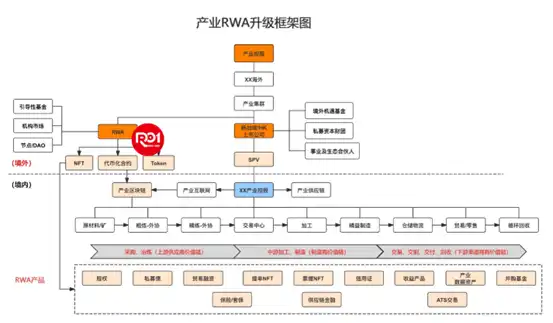
(Figure Traditional Manufacturing Industry RWA Upgrade Framework)
The advantage of traditional manufacturing lies in heavy assets (underlying assets and fixed assets) and the supply chain. Therefore, the RWA upgrade framework for the traditional manufacturing industry can be divided into four layers:
Layer one, RWA underlying assets, a distributed asset pool, including raw material mine assets, fixed assets, liquid assets, liability-type assets, and more; this involves the tokenization of underlying assets for RWAs, achieving asset on-chain pooling, distributed asset pools, dynamic pricing, etc.
Layer two, industrial chain space + industrial chain scenarios, revolving around the entire manufacturing industry chain of mining processing, international trade, supply chain finance, warehousing logistics, consumption, production, incentive scenarios, as well as core scenarios such as industry chain transactions and liquidity pools, all have opportunities for RWA tokenization.
Layer three, industrial finance (Defi) and industrial stablecoin + PayFI, industrial stablecoins and industrial payment settlement and investment and financing scenarios, as well as encrypted smart finance based on industrial RWA assets for lending, futures, insurance, etc.
The fourth layer, RWA Industry Trading Platform, the upgraded ultimate will inevitably be an industrial RWA trading platform, with exchanges or top-tier exchange's vertical track platform and platform token.
Around traditional industrial upgrades, it will face the transformation issue of digitization and chain-based asset transformation.
This foundational work can simultaneously start with RWA financing to drive infrastructure development, mainly achieving the industry's "controllable assets + trusted asset management," where controllable is for on-chain tradability, deliverability, or control of delivery; trusted asset management involves industrial asset tokenization fundraise management, asset issuance, trading/investment, management, and exit.
For industrial upgrades, for the institutional market, the core is corporate credit, where RWA's controllability and trustworthiness are similar to the on-chain credit mechanism or Oracle mechanism.
Thus: RWA, for a company, is a bond issuance; for an industry, it is a new platform for assets and funds; for a region or country, it is a digital asset, stablecoin, and cryptographic financial system.
#ARAW Always RWA Always Win!
By 2025, the RWA market will rapidly find its place amidst rapid growth. In the new year, Kai will officially start recruiting disciples to mentor and guide. Young talents aspiring to the RWA direction are welcome to take the lead.
More and more friends are coming to ask specific project questions, which cannot be answered in detail on WeChat. A disciple class and practical study camp will be launched soon, so come to the classroom to diligently comprehend, interact, and conduct sandbox scenarios. You can add WeChat YekaiMeta to join the RWA Industry Research Group for discussions.
This article is a contribution and does not represent the views of BlockBeats.
You may also like

Morning Report | Binance launches DYOR research tool; YZi Labs launches recruitment platform YZi Talent; Vitalik states that the Ethereum Foundation will "downsize" and reduce the amount of ETH sold

Morning News | Michael Saylor stated that this week he bought bonds instead of Bitcoin; StablR was attacked and lost about 2.8 million dollars; the U.S. Congress is pushing the Bitcoin Reserve Act again

SuperEx's Mars exploration dream: Digital currency is the key to unlocking economic exchanges in the interstellar era

Key Takeaways: Full Text of Google Chief Scientist Shanahan's Speech

Agentic Design Patterns: A book that made me rethink "What exactly is an Agent?"

The richest chairman of the Federal Reserve in 112 years has arrived: Kevin Warsh is rewriting the rules

Vitalik talks about the future of the Ethereum Foundation: a smaller, more distinctive, yet more enduring ship

New Types of Information Laundering in Prediction Markets: How Secrets Integrate into Investment Signals

Vitalik emphasized in a post that Ethereum must be "amazing," but the foundation is not the center
DeFi has reached its most dangerous moment: the real vulnerabilities are not in the code
WEEX Bitcoin Pizza Day: Zero Fees, BTC Cashback & 150,000 USDT to Honor Crypto History

a16z: 7 Images to Understand How Tokenization Changes the Nature of Assets

The secret to Hyperliquid's success dismantled from the five-layer financial stack
After Futu Securities was banned, will buying stocks on-chain be the new remedy?

Why Crypto Traders Are Watching Gold and Nasdaq Again in 2026
Why have foreign exchange stablecoins never taken off?

AIDC, computing power leasing, and cloud: The "three-part thesis" of AI transformation in cryptocurrency mining farms

Futu has had all its illegal gains confiscated, reminding cryptocurrency exchanges
Morning Report | Binance launches DYOR research tool; YZi Labs launches recruitment platform YZi Talent; Vitalik states that the Ethereum Foundation will "downsize" and reduce the amount of ETH sold
Morning News | Michael Saylor stated that this week he bought bonds instead of Bitcoin; StablR was attacked and lost about 2.8 million dollars; the U.S. Congress is pushing the Bitcoin Reserve Act again
SuperEx's Mars exploration dream: Digital currency is the key to unlocking economic exchanges in the interstellar era
Key Takeaways: Full Text of Google Chief Scientist Shanahan's Speech
Agentic Design Patterns: A book that made me rethink "What exactly is an Agent?"
The richest chairman of the Federal Reserve in 112 years has arrived: Kevin Warsh is rewriting the rules