
U.S. Pre-market Stock Plunge: Seven Giants Shed Over $500 Billion, Crypto Market Loses $100 Billion

Original Title: "US Stock Market Plunges in the Early Morning: Seven Giants Evaporate Over $500 Billion, Crypto Market Loses $100 Billion"
Original Author: Alvis, MarsBit Mars Finance
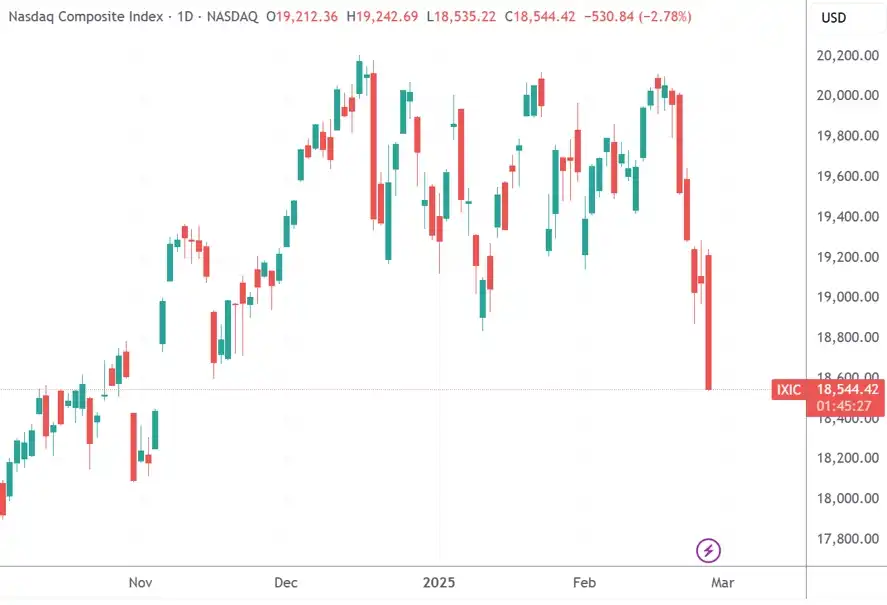
On the early morning of February 28th, despite investors believing they had smoothly passed Nvidia's financial report test, President Trump's remarks once again triggered a sharp market fluctuation. The US stock market faced a new round of selling pressure, with the S&P 500 index falling by 1.59% to close at 5861.57 points; the Nasdaq Composite Index plummeting by 2.78% to 18544.42 points; and the Dow Jones Industrial Average dropping by 0.45% to close at 43239.5 points.
This plunge affected the symbol of the US stock market bull market—the "Seven Giants" companies, whose total market value evaporated by approximately $550 billion (around 4 trillion RMB). Among them, Nvidia's stock price rose by 2% at the opening and then dropped by over 8% at the close, shrinking its market value by over $270 billion, marking the largest single-day market value loss since January 27th.
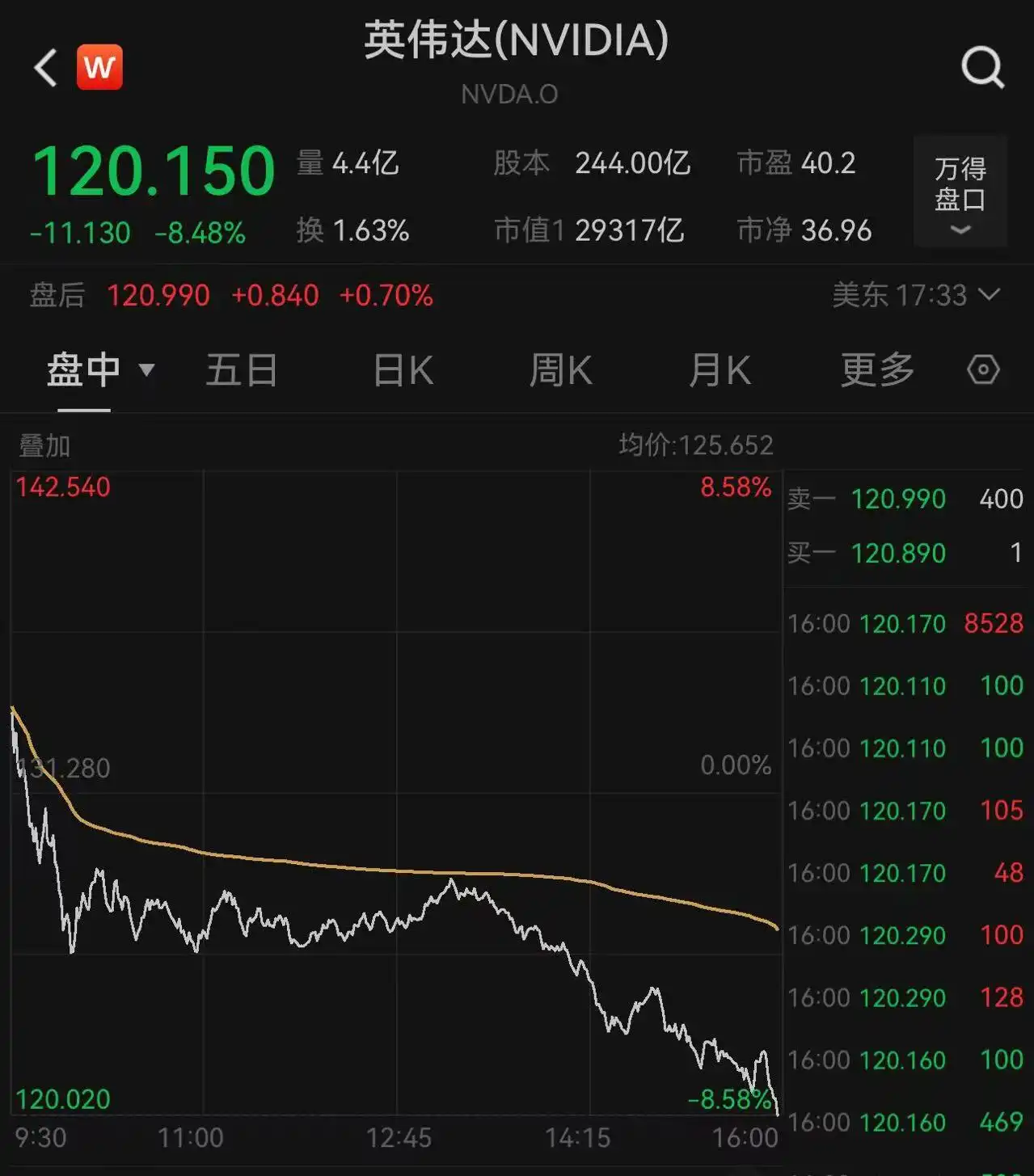
In Nvidia's latest financial report, both fourth-quarter revenue and profit exceeded market expectations, and the company also issued a strong performance guidance, showing a continued growth in demand for AI chips. However, despite the company's outstanding performance, the decline in gross margin and the slowdown in data center revenue growth failed to ignite market sentiment.
James Demotte, Chief Investment Officer of Main Street Research, pointed out that although Nvidia's performance was very impressive, the current market environment is unusually turbulent.
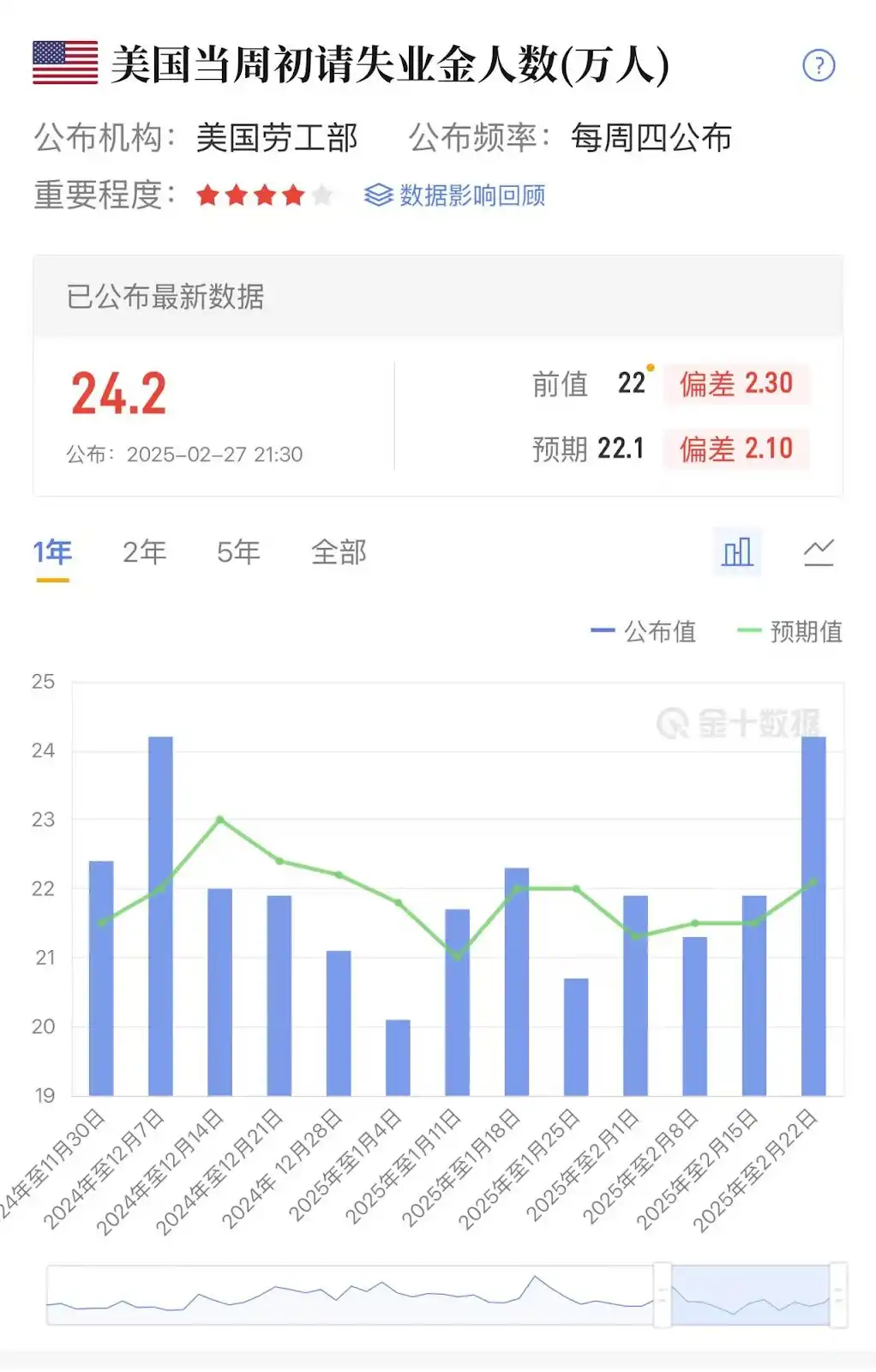
In addition to Trump's statement on tariffs, the weekly initial jobless claims data released on Thursday also deepened market concerns about the US economic outlook. The Labor Department's report showed that as of the week ending February 22nd, the number of US initial jobless claims increased to 242,000, an increase of 22,000 from the previous week.
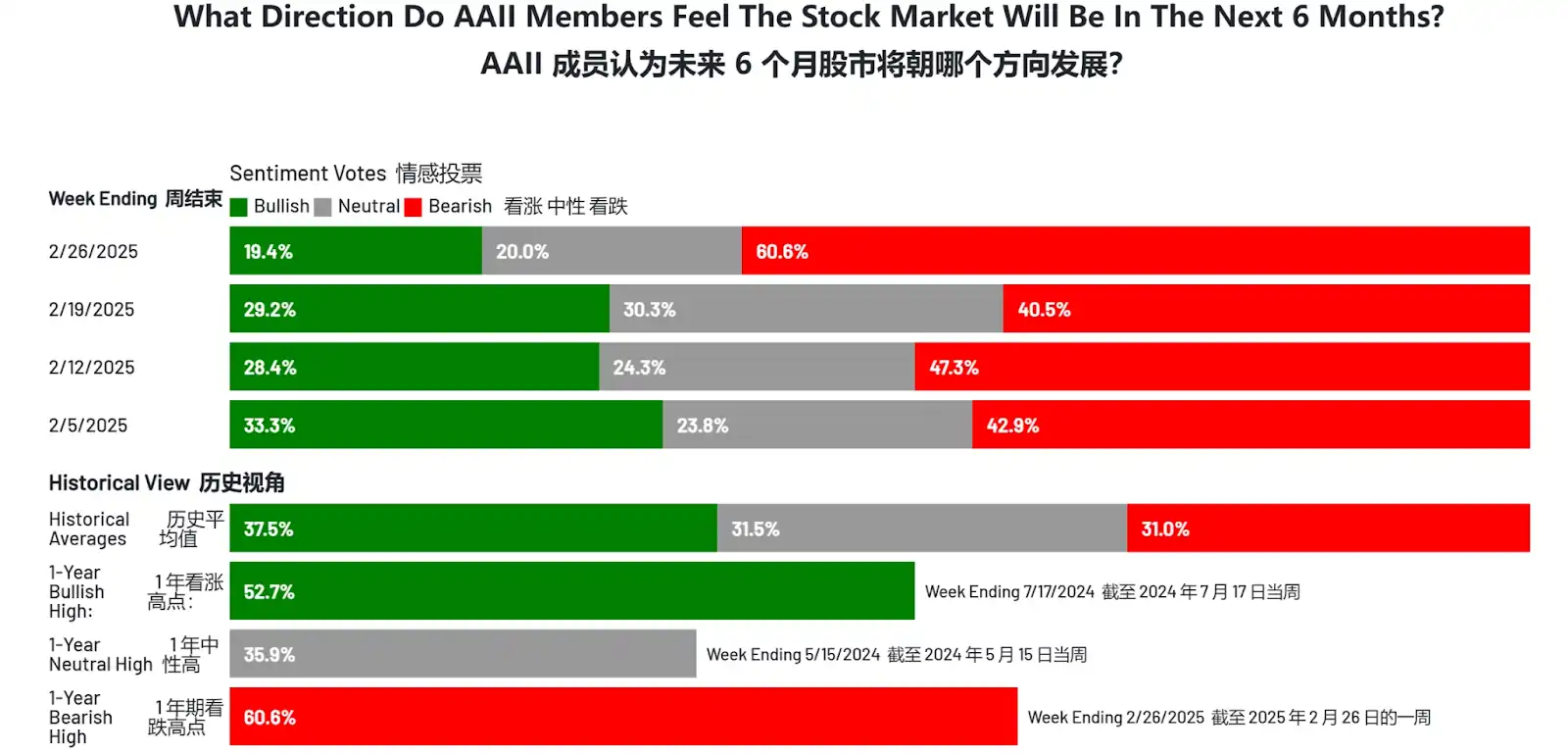
At the same time, there has been a significant change in retail investor sentiment. According to the latest survey by the American Association of Individual Investors, over 60% of respondents believe that the US stock market will decline in the next six months, a proportion that has surged by 20% from the previous week. Against the backdrop of the US stock market nearing its historical highs, retail investors' pessimistic sentiment has instead intensified market uncertainty.
The Crypto Stock Market Was Not Spared Either
Cryptocurrency-related stocks also experienced a sharp decline. According to Snowball data, out of the 14 cryptocurrency stocks listed in the United States, 11 declined, while only 3 saw gains.
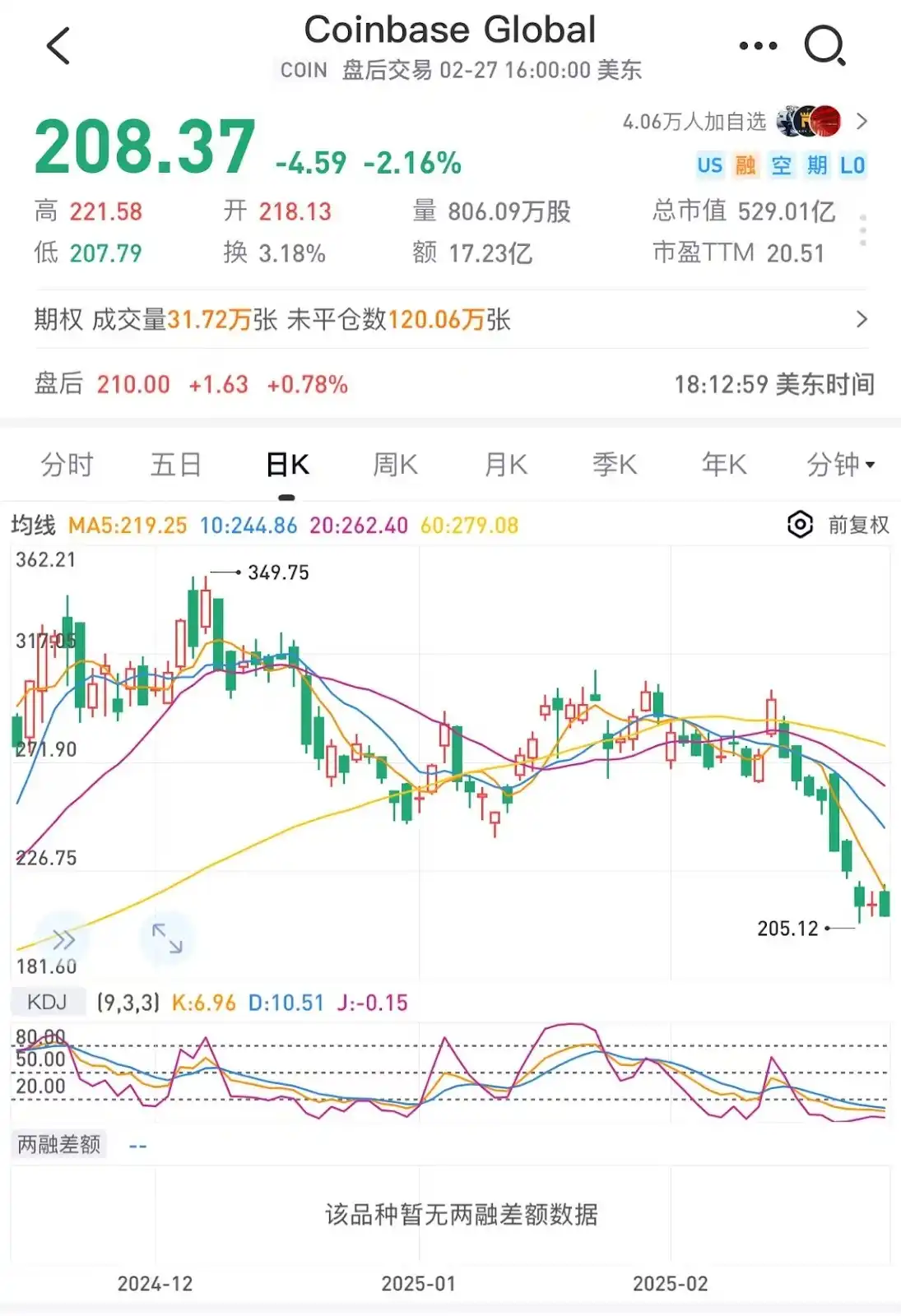
Particularly, Coinbase, despite its February 13 financial report showing a positive outlook for 2024 performance, has still accumulated a decline of over 30% in the past three weeks.
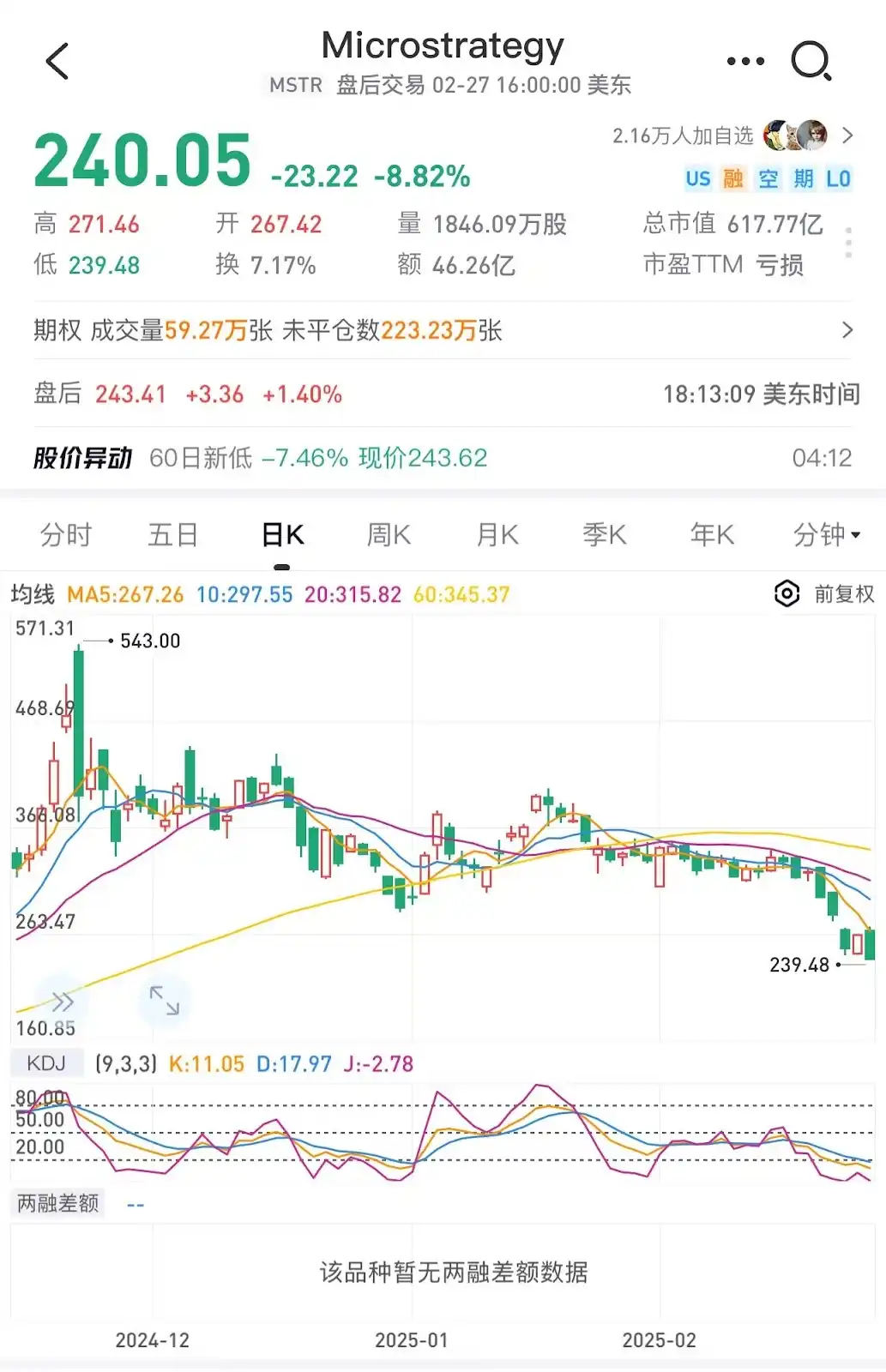
Furthermore, MicroStrategy also experienced a nearly 9% drop earlier today, with a total decline of over 30% in the past three weeks.
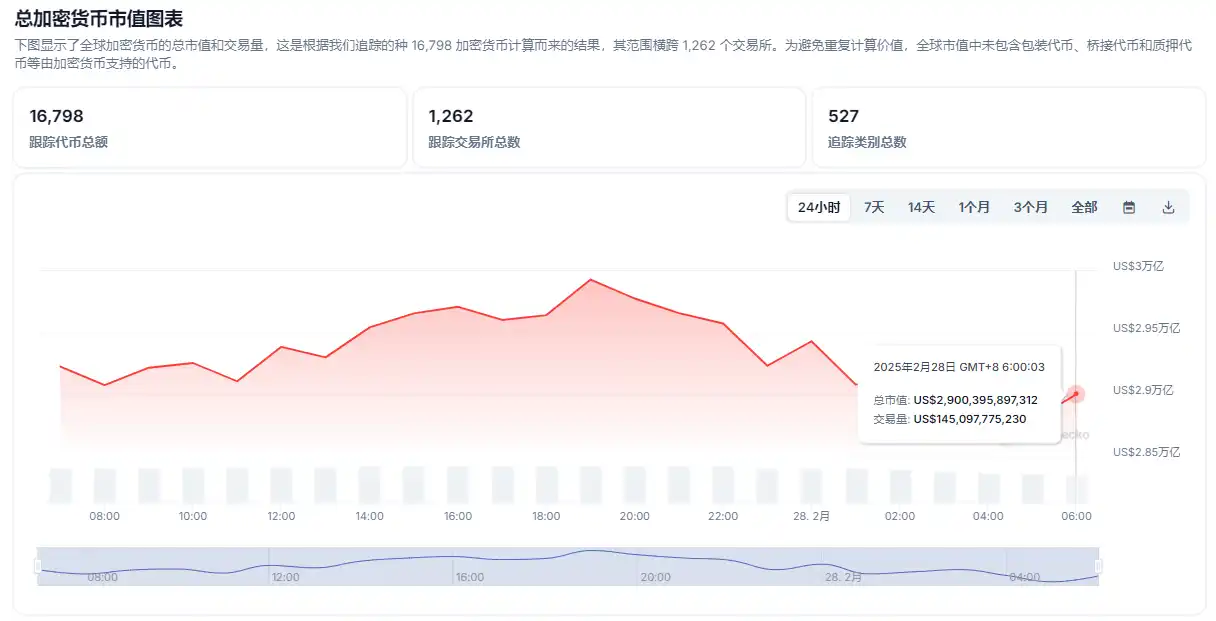
The cryptocurrency market was similarly hit hard, with Bitcoin retracing from its peak of $87,000 to $82,700, while Ethereum hit a new low of $2,230.
The overall crypto market cap dropped from $3 trillion to the current $2.9 trillion, evaporating $100 billion.
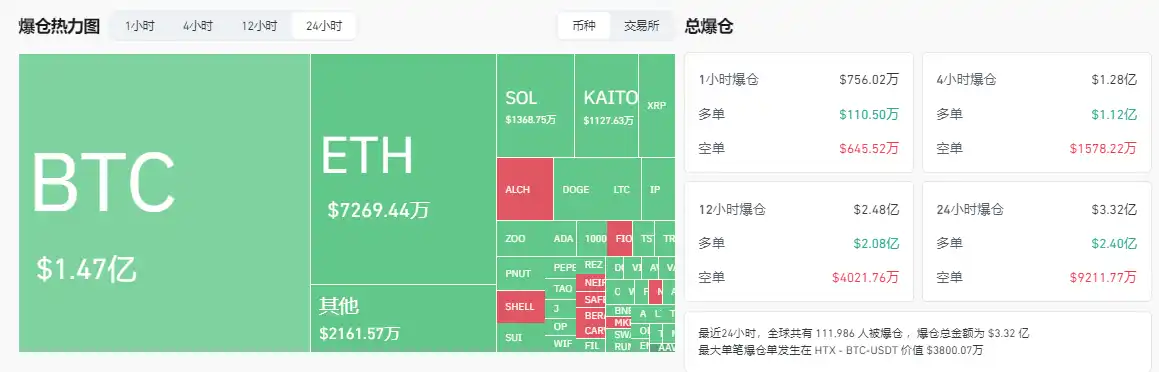
In the past 24 hours, the total amount of liquidated long positions across all networks exceeded $332 million, continuing to be borne by longs. Over the past five days, the total amount liquidated has exceeded $4 billion.
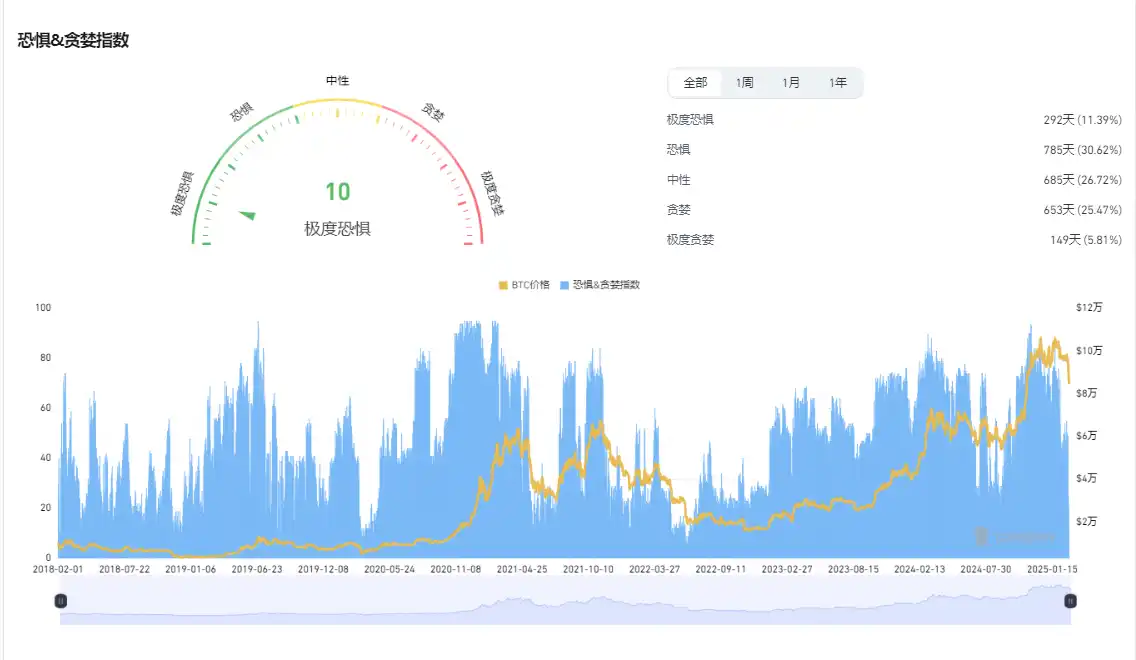
The current Fear & Greed Index is at 12, hitting a new low since June 2022. Market sentiment is in a state of extreme fear, with investors expressing concerns or uncertainties about future price trends.
Why Has Bitcoin Been Falling Recently?
Trade War Concerns Lead to Bitcoin Price Decline
Despite the U.S. government strongly advocating for Bitcoin policies, the price of Bitcoin has fallen amid increased market uncertainty, contrary to expectations. Usually, in periods of economic uncertainty, cryptocurrencies like Bitcoin are often seen as high-risk assets and are thus influenced by factors such as geopolitical tensions and tariff threats. Particularly under the anxiety of a trade war, the market has generally entered a panic mode, with investors flocking to safe-haven assets. While the U.S. government broadly supports digital currency, the volatile nature of assets like Bitcoin has lost its upward momentum in the current market environment.
Bitcoin ETF Withdrawal Highlights Institutional Investor Concerns

Adding to the complexity is the significant outflow of funds from Bitcoin ETFs. According to Sosovalue data, Bitcoin has seen net outflows for over 7 consecutive days, with a single-day outflow hitting a record $1 billion. Bitcoin ETFs have experienced net outflows of over $2.4 billion in the past week. These withdrawal actions reflect institutional investors' widespread uncertainty about the short-term market trend.
SEC Case Dismissals Hint at Crypto Policy Change
The U.S. Securities and Exchange Commission (SEC) recently dismissed enforcement cases against major crypto platforms like Coinbase and MetaMask, indicating a shift in regulatory strategy under the new leadership. SEC Acting Chair Mark Uyeda and crypto advocate Hester Peirce played crucial roles in driving this change. Coinbase's Chief Legal Officer Paul Grewal stated that the company will continue to collaborate with regulatory agencies to promote positive development in the cryptocurrency space.
Crypto Industry Confident in Clear Legislation
Overall, the crypto industry is optimistic about clear regulatory legislation. For instance, the crypto bills proposed by Senators Cynthia Lummis and Kyrsten Sinema could lay the groundwork for market growth and help the U.S. maintain its leadership in the global crypto sector. While the price of Bitcoin continues to be influenced by global economic and geopolitical factors, the complex relationship between trade wars and cryptocurrency remains a key challenge for the market. Government support for Bitcoin may bring long-term benefits, but short-term economic pressures could still impact investor sentiment.
You may also like

Morning News | Hyperliquid launches off-chain event prediction market contracts; Strategy completes $1.5 billion debt buyback; Kelp DAO announces rsETH has fully recovered

Bankless Founder: Why I Sold All My ETH

Senior Public Company Financial Audit: Taking Hashkey as an Example, Discussing Which Account to Include for Exchange Issued Platform Tokens?

How did Micron win a trillion-dollar market value while Samsung relies on technology cycles and Hynix relies on HBM?

Dialogue with AEON co-founder Leo: The real bottleneck of the Agentic Economy is not the model, but the settlement
2 years, 225 times the return? Unveiling the mysterious researcher Serenity's AI "bottleneck" investment technique

B.AI partners with BNB Chain to launch the "Billion AI Token Subsidy" celebration, fully igniting the on-chain intelligent agent ecosystem

The trillion-dollar frenzy of selling memory, profits from buying memory are halved

Who can make money in the era of Agents?

From brokerages to banks, Hong Kong intensifies efforts to clean up cross-border investment account openings

DeFi has reached its most dangerous moment: the real vulnerabilities are not in the code

Morning Report | Binance launches DYOR research tool; YZi Labs launches recruitment platform YZi Talent; Vitalik states that the Ethereum Foundation will "downsize" and reduce the amount of ETH sold

Insiders betting on Musk are reaping "historic returns."
Ten Thousand Characters Breakdown of On-Chain Vaults: Eight Major Tracks, Who is Rising and Who is Declining?

Behind NEAR's Doubling: 3 Major Trends Becoming the Engine of Coin Prices
Visa and Stripe are both working on stablecoins, but their focus is not on payments

How Traders Keep Profits When PEPE WLD and FET Start Moving Fast Again

It's easy to conquer a city, but difficult to govern it: Polymarket wants to establish a presence globally but still has to bow down everywhere
Morning News | Hyperliquid launches off-chain event prediction market contracts; Strategy completes $1.5 billion debt buyback; Kelp DAO announces rsETH has fully recovered
Bankless Founder: Why I Sold All My ETH
Senior Public Company Financial Audit: Taking Hashkey as an Example, Discussing Which Account to Include for Exchange Issued Platform Tokens?
How did Micron win a trillion-dollar market value while Samsung relies on technology cycles and Hynix relies on HBM?
Dialogue with AEON co-founder Leo: The real bottleneck of the Agentic Economy is not the model, but the settlement
2 years, 225 times the return? Unveiling the mysterious researcher Serenity's AI "bottleneck" investment technique