
The current Lobster Skill is just yesterday's Fruit Ninja, only meant to get you acquainted.

The phenomenon of "Lobster" OpenClaw has become extremely popular in China, to the point where even Ma Huateng shared Tencent's free installation of the open-source AI agent OpenClaw on his WeChat Moments, commenting, "Didn't expect it to become this popular."

During the National People's Congress and Chinese People's Political Consultative Conference (Two Sessions), National People's Congress delegate and Chinese Academy of Engineering academician Gao Wen also mentioned this phenomenon in his speech, stating, "Now everyone is in a rush, afraid of not raising a lobster."
However, now that "lobsters" are available, what exactly are people doing with them? A possibly more typical and ideal case scenario is as follows:
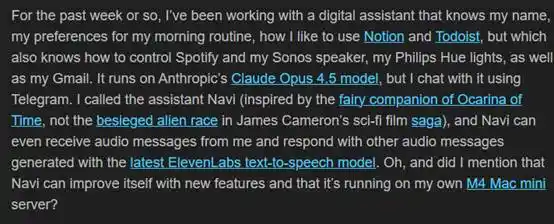
"For the past week or so, I've been using a digital assistant that knows my name, understands my morning routine, knows how I like to use Notion and Todoist, and can also control Spotify and my Sonos speaker, Philips Hue lights, and my Gmail. It runs on the Anthropic Claude Opus 4.5 model, but I interact with it through Telegram. I've named this assistant Navi, and Navi can even receive my audio messages, using the latest ElevenLabs text-to-speech model to generate other audio messages in response. Oh, and I haven't mentioned that Navi can self-improve through a new feature, and it's running on my own M1 Mac Mini server."
The author of the above case scenario mentioned that he has already burned 180 million tokens on the Anthropic API, possibly spending $2000 to "raise a lobster."
It may sound like the cost of "raising a lobster" is not low, and the things it can do may not be very advanced. It seems more like a "XX Elf" that can communicate with humans in a humane way and help humans automate more work. In fact, this is the role that "lobsters" can play at this stage—an "AI assistant."
If we take a look at the top 100 installation rankings on ClawHub and roughly classify them, we can better understand that using large models to do these things often amounts to "using a sledgehammer to crack a nut":
- Information retrieval category: Searching, extracting, integrating, and summarizing information from various sources (external links, local files, APIs). Practical use cases include AI-optimized and summarized searches on Google, Baidu, etc., having the "lobster" send you the weather forecast daily, and sending real-time Bitcoin prices.
- Productivity (Workflow Automation) Category: Handles email, Notion, Github, Obsidian, Slack, etc., and is able to further achieve cross-platform task automation, streamline workflows, and provide a single entry point for dealing with multiple platforms.
- Developer Tools Category: Professional tools for developers and technical users, offering features such as code management, API interaction, server management, etc. Enhances development efficiency and enables automation of coding, testing, and deployment. This category is programmer-oriented, such as interacting with GitHub via the command line, handling issues, PRs, CI runs, and advanced queries.
- Content Creation Category: Utilizes AI generation capabilities to create or edit text, images, audio, and other multimedia content.
- IoT Control Category: Connects to and controls smart home devices, audio systems, and other smart home hardware. For example, enabling scheduled control of home curtains and lights.
Overall, the popularity of "Lobster" is not due to how exceptionally well it can perform the above tasks, but rather its ability to act as a comprehensive "assistant." Unlike most users who may simply use a particular AI tool as a search engine or automatic image editing software, "Lobster" allows individuals to use chat applications like Telegram to interact with it in a conversational manner and assign various types of tasks, similar to interacting with a boss. This novelty is amplified through word of mouth, making it an unprecedented integration of AI into people's lives.
We can even take a more optimistic view of the current seemingly idle stage of "Lobster." In the early days of the iPhone, we could only play games like Balance Ball, Angry Birds, and Fruit Ninja to showcase how a touchscreen could be used. In terms of the content and entertainment value of the games themselves, they were not even as entertaining as the abundant Java games on Nokia phones. But now, young people play games like Honor of Kings, Delta Force, and many even exclusively play mobile games without touching PC games.
If we shift our focus to the current cryptocurrency market, "Lobster" is likely to significantly lower the learning curve between cryptocurrencies and the general public once again, effectively addressing the widespread investment demand of the public.
Of course, this is not referring to meme trading or creating tokens using "Lobster." Nowadays, the variety of on-chain tradable assets is becoming increasingly diverse, from US stocks, crude oil, and gold to Pokémon cards... All of these can be traded on-chain in a decentralized, 24/7, and low-threshold manner. The trading volume is substantial. On February 6, Hyperliquid's on-chain Perp DEX and Trade.xyz, primarily trading US stocks, achieved a 24-hour trading volume of $5.45 billion, setting a new all-time high.
In this age of information abundance, what often hinders us from capturing new investment opportunities is the "barrier to entry." For example, some time ago, when memory prices surged, everyone could be aware of this information. However, going directly to buy SK Hynix's stock is quite troublesome for non-Korean residents. Account opening, fund settlement, and so on, all impede the public from making immediate investment actions based on this information.
But what if the path becomes:
- Let the "Lobster" have a wallet
- Purchase stablecoins via credit card to fund the "Lobster" wallet
- Tell the "Lobster" the specific investment target
- The "Lobster" conducts the buy/sell on-chain
All these can be easily done through a chat-like conversation, which undoubtedly presents an explosive growth opportunity for the "Lobster" and cryptocurrency.
We also have prediction markets, so we can imagine more. For instance, while taking a taxi, you have a chat with the driver. The driver mentions they think the next U.S. president will be A, you believe it will be B, and in the midst of the disagreement, you voice command to your "Lobster" - place a $100 bet for me on B to win.
Your "Lobster" understands your intent, automatically finds the prediction market with the best liquidity to place the order. The driver promptly follows suit, using the in-car system's voice command, also placing a $100 bet on A to win with their "Lobster" on the prediction market.
Furthermore, the "Lobster" may also introduce features to regulate underage consumer spending, preventing children from impulsive spending via their "Lobster" on-chain trading cards market while showing off their Pokémon cards.
If the meme coin frenzy driven by pump.fun was the 1.0 version of the attention economy's "everything tokenization," then the "Lobster," this new paradigm of ordinary people using AI more simply, could potentially become the 2.0 version - it can find on-chain all the investment targets and channels we want to invest in immediately and execute based on our intent. Moreover, it will expand the on-chain ecosystem from investment to consumption, truly unlocking the Mass Adoption that blockchain has been pursuing for years.
The future is unfolding.
You may also like

Circle CEO responds to OUSD's challenge: Stablecoins are a winner-takes-all business, and we will not slow down
Argentina vs Cape Verde: When a Record-Breaking Legend Meets an Unbreakable Underdog
WEEX exclusive pre-match analysis of Argentina vs Cape Verde, exploring Messi-led Argentina’s dominance and Cape Verde’s historic defensive breakout, with a breakdown of volatility, structure, and match dynamics.
How does Gate redo "buying and selling stocks" from the cryptocurrency world to the stock market?
Former ByteDance employee's account: How I started with two Pinduoduo hard drives and made six times the profit with Seagate to achieve financial freedom?
Visa and Mastercard join 140 giants to launch a new stablecoin, but the impact on the market landscape may still be limited
WEEX Launches Depth Chart for Spot Trading
MiCA reshuffle begins, Binance temporarily bids farewell to the EU
Raising interest rates to protect STRC and selling coins to maintain credit, this time the strategy has chosen the two most expensive paths
Morning Report | Samsung announces a 265.5 trillion won investment plan, focusing on semiconductor and AI computing power data centers; Vitalik publishes an article detailing the entire technology tree behind the confusion protocol (iO) mainline
In the era of AI, what is left of Bitcoin?
NeoSoul announced plans to integrate with the OKX Agentic Wallet, promoting AI agents' participation in the on-chain economy
Why Is Bitcoin Lagging Stocks in 2026? AI Stocks, ETF Outflows, and the Nasdaq Rally Explained
What you bought on CEX is really not US stocks: Analyzing the 94% liquidation monopoly and the evaporation of equity under a five-layer pipeline
In such a crowded cross-border payment arena, where is the next stop for the future?
Why Is Bitcoin Down in 2026? What We Can Learn From 2022
The large models in the United States are moving towards closure in the name of security
From the white-haired stock god to the billionaire fund mogul, the smart people shorting Nvidia are all getting rich using the same framework
Morning Report | CoinEx becomes a key hub for Iran to evade sanctions, involving over $3.8 billion in funds; Kalshi seeks a new round of financing, with a valuation potentially rising to $40 billion
Circle CEO responds to OUSD's challenge: Stablecoins are a winner-takes-all business, and we will not slow down
Argentina vs Cape Verde: When a Record-Breaking Legend Meets an Unbreakable Underdog
WEEX exclusive pre-match analysis of Argentina vs Cape Verde, exploring Messi-led Argentina’s dominance and Cape Verde’s historic defensive breakout, with a breakdown of volatility, structure, and match dynamics.
How does Gate redo "buying and selling stocks" from the cryptocurrency world to the stock market?
Former ByteDance employee's account: How I started with two Pinduoduo hard drives and made six times the profit with Seagate to achieve financial freedom?
Visa and Mastercard join 140 giants to launch a new stablecoin, but the impact on the market landscape may still be limited
WEEX Launches Depth Chart for Spot Trading

Popular coins
Latest Crypto News


