
CoinGecko Spot Report: Overview of 12 Major CEX Spot Markets, Only 32% of New Tokens Outperforming IEO Price

Original Article Title: Spot CEX Report 2026
Original Source: CoinGecko
Original Translation: Deep Tide TechFlow
Deep Tide Summary: CoinGecko has released the 2026 Spot CEX Report, covering the top 12 global centralized exchange platforms. The report revealed several key facts: USDT and USDC account for nearly 98% of stablecoin trading pairs; only 32% of newly listed tokens outperformed their issuance price in the short term, with almost all dipping below the issuance price after 12 months; total reserves on exchanges increased from $1.521 trillion to $2.254 trillion; funds are flowing from institutional platforms like Coinbase to retail-driven platforms like Bitget and MEXC.
Since the birth of the crypto market, centralized exchange platforms (CEXs) have been the core gateway for both retail and institutional players to access liquidity. In just 2025, the spot markets of the top 12 CEXs processed nearly $21 trillion in trading volume. As the industry matures, the focus of the market is shifting towards the sustainability of spot trading activity and the health of the underlying reserves supporting these massive trades.
The competitive landscape of CEXs is evolving. USDT and USDC dominate trading pairs, and the performance of newly listed coins remains a significant challenge. The total reserves of the top 12 CEXs in 2026 reached $2.254 trillion, with funds moving from institutional giants towards high-turnover, retail-driven platforms.
Below are the four key findings of the report. The full report spans 21 pages, and it is recommended to download and read.
1. USDT and USDC Account for 66.6% of Trading Pairs, Stablecoins Almost Monopolize Spot Trading
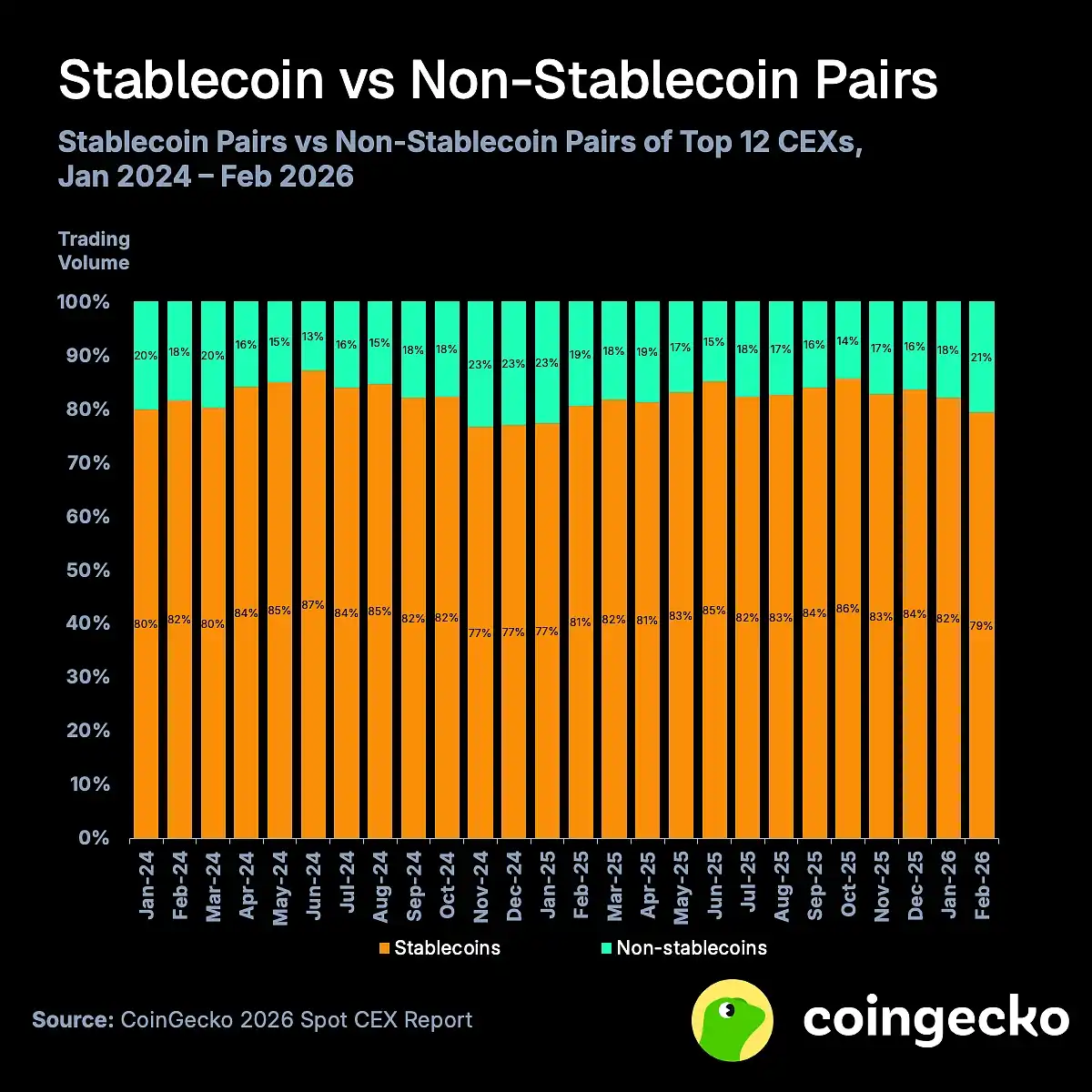
Figure: Proportion of Stablecoin and Non-Stablecoin Trading Pairs on the Top 12 CEXs
The vast majority of spot trading volume on the top 12 CEXs is completed through stablecoin trading pairs like USDT and USDC.
Specifically, out of 9,870 stablecoin trading pairs, 9,646 are USDT or USDC pairs, accounting for 97.7%. There are a total of 4,615 non-stablecoin trading pairs, representing 31.9% of all 14,485 trading pairs.
However, the number of trading pairs does not directly correlate with trading volume. The share of non-stablecoin trading pairs reached its peak in November 2024, at only 23%.
2. Peak of New Coin Listing: Only 32% Saw Short-Term Gains, Nearly Wiped Out After 12 Months
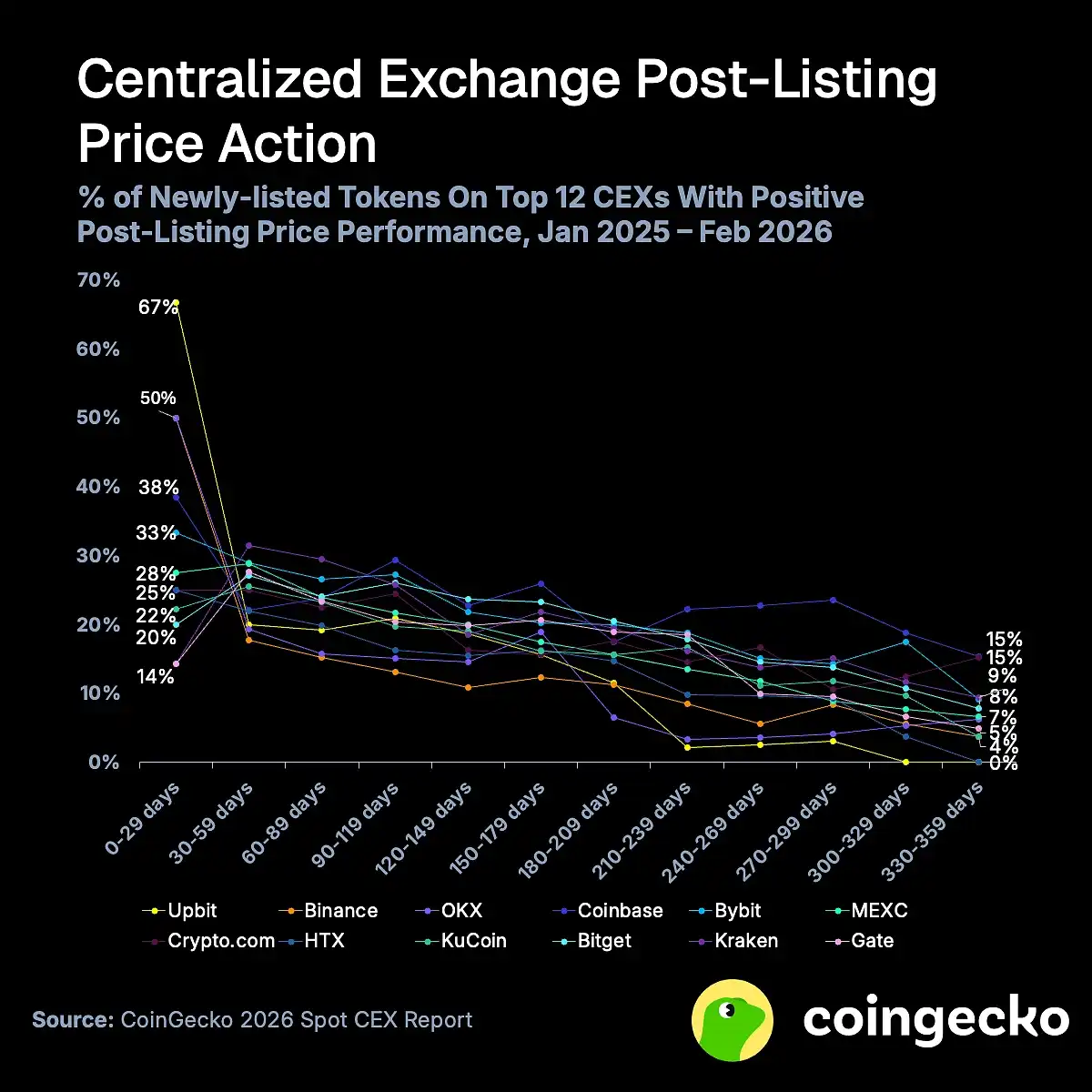
Chart: Price Performance of 12 Major CEX-Listed Tokens
Among the top 12 exchanges, Upbit had the best short-term performance after listing new coins, with 67% of new coins still profitable after 30 days of listing. However, Upbit also had the fewest listings. Following Upbit were Binance and OKX, with a 50% profit rate after 30 days.
There was a significant performance difference among exchanges in the first 0-29 days after listing, but the gap rapidly narrowed after 30 days. On average, only 25% of tokens were still profitable 30-59 days after listing.
Looking at a longer time frame, the performance of exchanges tended to linearly decline. The only exception was Coinbase, where newly listed tokens saw a "recovery" six months after listing.
By the 12-month mark, in most tokens listed on major exchanges, less than 10% were trading above the listing price. Upbit's data was particularly dramatic: starting strong but crashing the fastest, by days 300-329, all newly listed tokens were trading below the listing price.
3. Total Reserves of 12 Major CEXs Increased from $152.1B to $225.4B, Binance Doubled its Lead
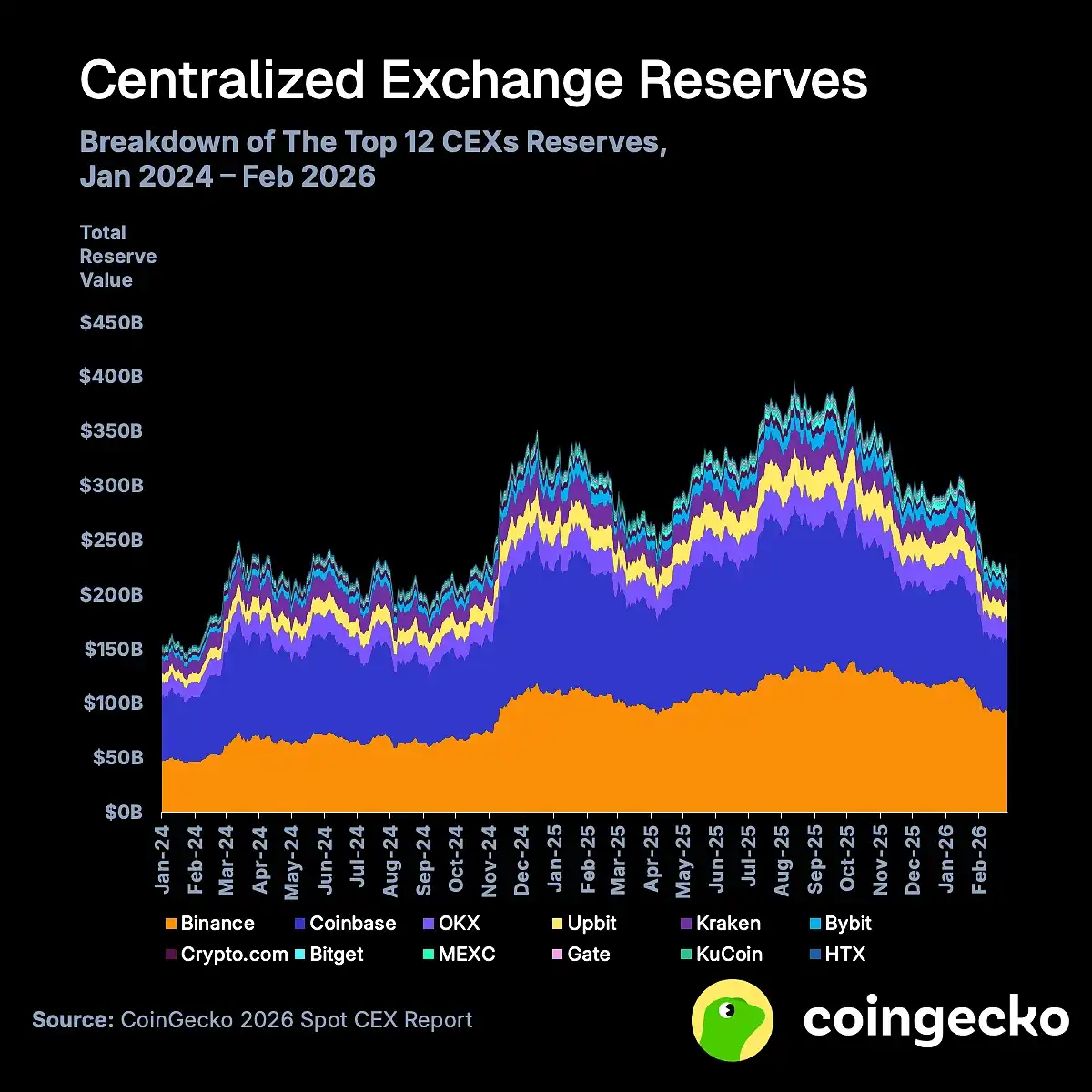
Chart: Changes in Value of 12 Major CEX Reserve Assets (2024-2026)
Despite the price surge of BTC and ETH boosting the reserve value of most exchanges, price volatility and stricter regulations are driving users to move funds from large exchanges to other platforms.
From early 2024 to the end of February 2026, the total value of underlying assets of the top 12 CEXs grew by an average of 69.6%, rising from $152.1 billion to $225.4 billion.
8 of the exchanges saw a net reserve gain, with Binance in the lead by far, doubling its reserves from $46.7 billion to $93.4 billion over 2 years.
With respect to BTC reserves, Coinbase holds the top spot with over 800k BTC, followed closely by Binance with 669k BTC. However, Coinbase saw net outflows of 20% and 41% of its BTC and ETH reserves, respectively.
A significant portion of these outflows flowed into smaller exchanges like Bitget and MEXC. The reserve value of these two platforms surged by 262.0% and 274.6%, respectively.
4. Retail-Centric Exchanges See Much Higher Capital Velocity Than Institutional Ones, With MEXC Turnover Rate 20x That of Coinbase
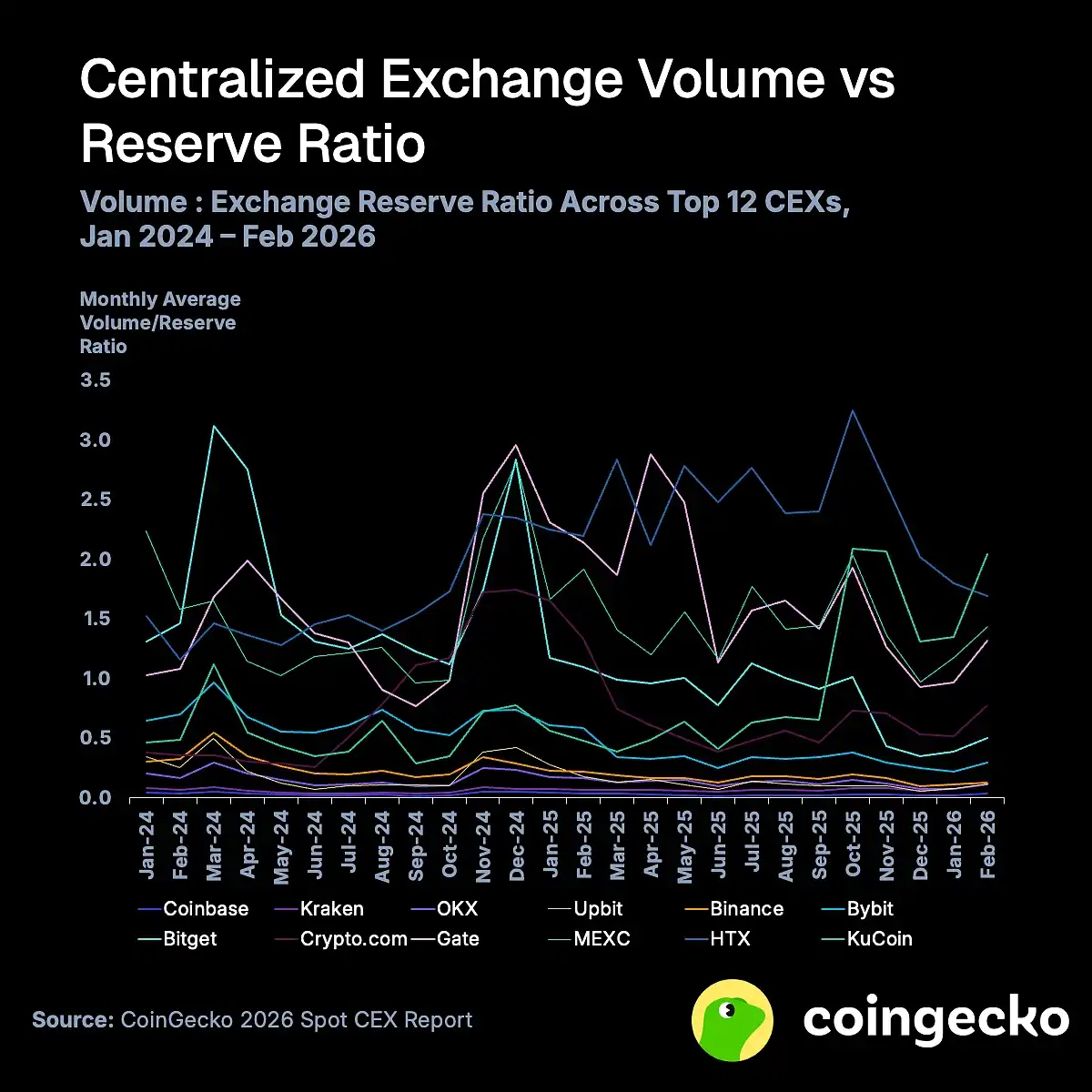
Figure: Comparison of the trading volume and reserve ratios of the top 12 CEXs
While CEXs hold significant crypto asset reserves, the efficiency of capital utilization varies greatly among platforms.
Compliant exchanges like Coinbase, Binance, and Kraken have a Volume : Reserve Ratio of around 0.1. This may be because their customer base is primarily institutional, using the platforms more for custody rather than frequent trading.
Bybit and Bitget combine high trading volumes with substantial deposit sizes, with average ratios from January 2024 to February 2026 of 0.3 and 0.5, respectively.
Exchanges with smaller reserves, such as MEXC, HTX, and KuCoin, have asset turnover rates ranging from 1.44 to 2.04. This means that users' trading volume far exceeds the exchange's held reserves, with funds circulating rapidly on the platform.
You may also like

Morning Report | Binance launches DYOR research tool; YZi Labs launches recruitment platform YZi Talent; Vitalik states that the Ethereum Foundation will "downsize" and reduce the amount of ETH sold

Morning News | Michael Saylor stated that this week he bought bonds instead of Bitcoin; StablR was attacked and lost about 2.8 million dollars; the U.S. Congress is pushing the Bitcoin Reserve Act again

SuperEx's Mars exploration dream: Digital currency is the key to unlocking economic exchanges in the interstellar era

Key Takeaways: Full Text of Google Chief Scientist Shanahan's Speech

Agentic Design Patterns: A book that made me rethink "What exactly is an Agent?"

The richest chairman of the Federal Reserve in 112 years has arrived: Kevin Warsh is rewriting the rules

Vitalik talks about the future of the Ethereum Foundation: a smaller, more distinctive, yet more enduring ship

New Types of Information Laundering in Prediction Markets: How Secrets Integrate into Investment Signals

Vitalik emphasized in a post that Ethereum must be "amazing," but the foundation is not the center
DeFi has reached its most dangerous moment: the real vulnerabilities are not in the code

WEEX Bitcoin Pizza Day: Zero Fees, BTC Cashback & 150,000 USDT to Honor Crypto History

a16z: 7 Images to Understand How Tokenization Changes the Nature of Assets

The secret to Hyperliquid's success dismantled from the five-layer financial stack
After Futu Securities was banned, will buying stocks on-chain be the new remedy?

Why Crypto Traders Are Watching Gold and Nasdaq Again in 2026
Why have foreign exchange stablecoins never taken off?

AIDC, computing power leasing, and cloud: The "three-part thesis" of AI transformation in cryptocurrency mining farms

Futu has had all its illegal gains confiscated, reminding cryptocurrency exchanges
Morning Report | Binance launches DYOR research tool; YZi Labs launches recruitment platform YZi Talent; Vitalik states that the Ethereum Foundation will "downsize" and reduce the amount of ETH sold
Morning News | Michael Saylor stated that this week he bought bonds instead of Bitcoin; StablR was attacked and lost about 2.8 million dollars; the U.S. Congress is pushing the Bitcoin Reserve Act again
SuperEx's Mars exploration dream: Digital currency is the key to unlocking economic exchanges in the interstellar era
Key Takeaways: Full Text of Google Chief Scientist Shanahan's Speech
Agentic Design Patterns: A book that made me rethink "What exactly is an Agent?"
The richest chairman of the Federal Reserve in 112 years has arrived: Kevin Warsh is rewriting the rules

Contents
Popular coins
Latest Crypto News