
Bloomberg has reported twice, Hyperliquid once again in Wall Street's radar

At 1:12 AM EST on February 28, during the exchange downtime, the trading volume of the prediction contract on Polymarket regarding the US striking Iran surged.
Source: @yenwod_
At 1:13 AM, the first open-source intelligence tweet about the airstrike appeared on Twitter.

One minute later, the price and trading volume of the crude oil perpetual contract on Hyperliquid's Trade.xyz followed an anomaly.
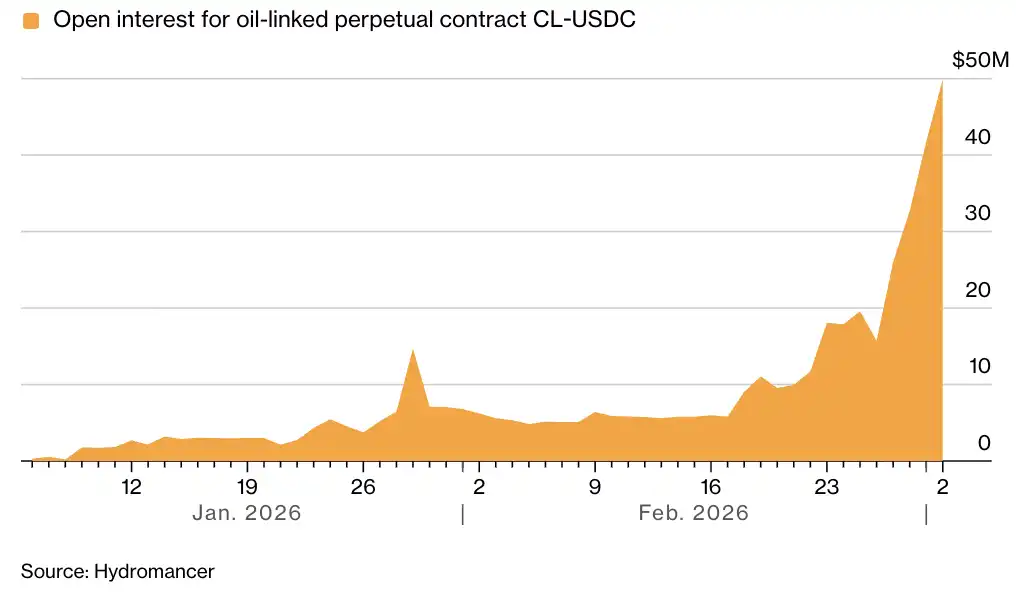
After the headline news broke, the crude oil perpetual contract on the Hyperliquid platform rose by 5%, with OI reaching $50 million. HYPE's price increased by 13%, leading the top 25 tokens by market cap.
24/7 Trading
Out of the past year's ten high-volatility macroeconomic events, eight occurred over the weekend. Hyperliquid's round-the-clock price discovery mechanism is drawing attention from the traditional financial markets.
In two recent articles about Hyperliquid, Bloomberg pointed out that as the intersection between the crypto market and traditional finance deepens, Wall Street is starting to closely watch platforms like Hyperliquid. During weekends when traditional markets are closed, on-chain derivatives offer continuous risk pricing capabilities. Bloomberg cited market participants stating that this round-the-clock pricing mechanism is a structural upgrade to enhance market efficiency. Weekend market movements validate a trend where round-the-clock on-chain trading of all asset classes is an inevitable direction for financial market development.
Decoupling
With the growth of HIP-3 supporting traditional market trading, HYPE's price performance has already begun to decouple from the default benchmark of the crypto market, Bitcoin. When news of the strike broke, the price of Bitcoin briefly fell and entered a period of volatility. In contrast, HYPE, which caters to trading demands for precious metals, stocks, and more, showed an independent trend.
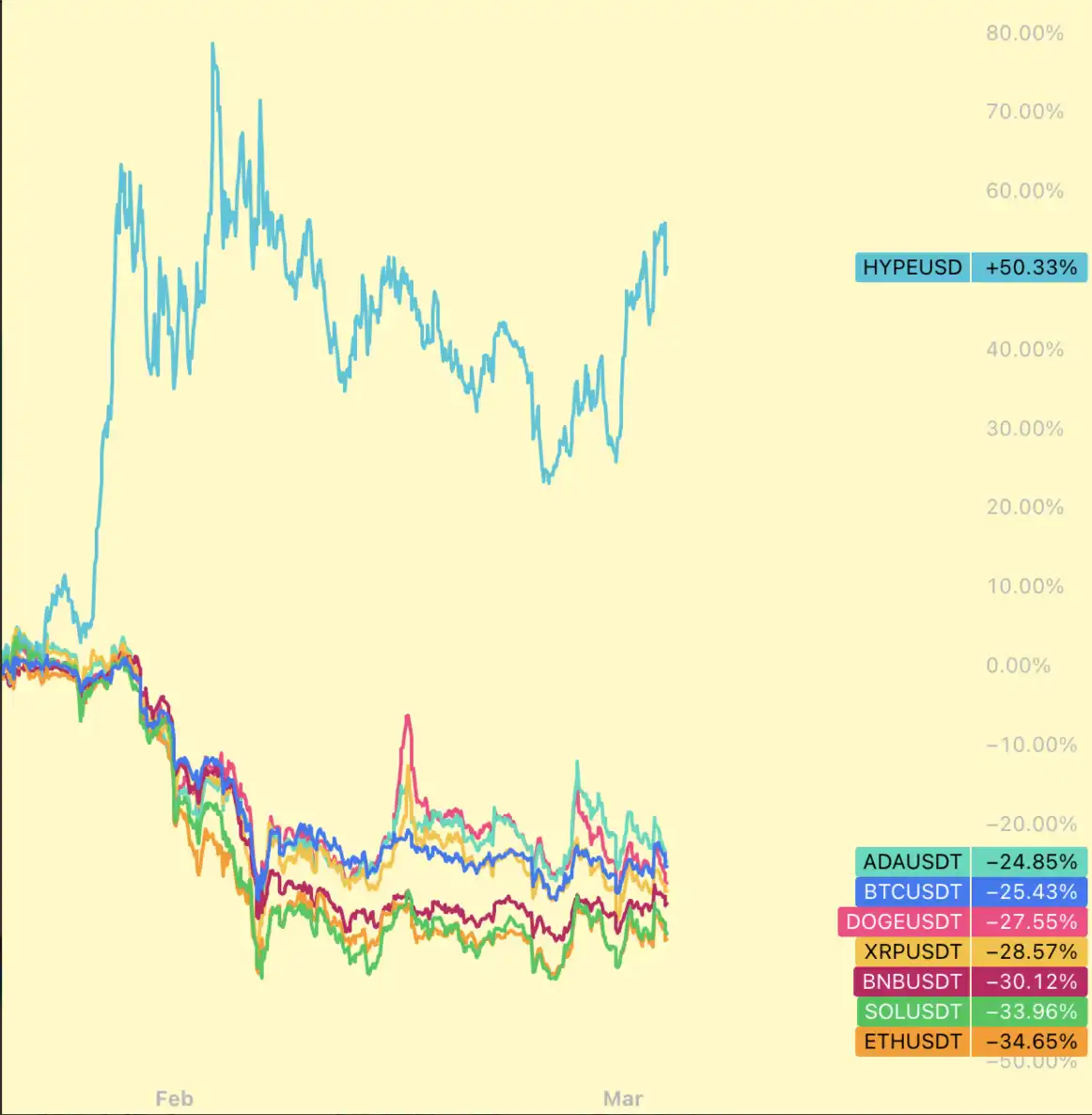
In late January, when silver broke $100 and gold broke $5500, the trading volume of silver-only contracts on the HIP-3 exchange tradexyz reached $1.2 billion, driving HYPE's 55% increase in three days, while Bitcoin only rose by 3% during that period.
Surge in Gold, Silver, and Copper Contract Trading Volume onTrade.xyz Since January
The Tokenomics explained the reason behind the HYPE surge. Hyperliquid's HIP-3 protocol dictates that 50% of all fee revenue generated by HIP-3 exchanges flows into the Hyperliquid Official Aid Fund for HYPE buybacks. Macro volatility drives up trading volume, increasing the buyback size, creating strong buying pressure for the HYPE token.
Fee Revenue Generated by HIP-3 Exchanges on
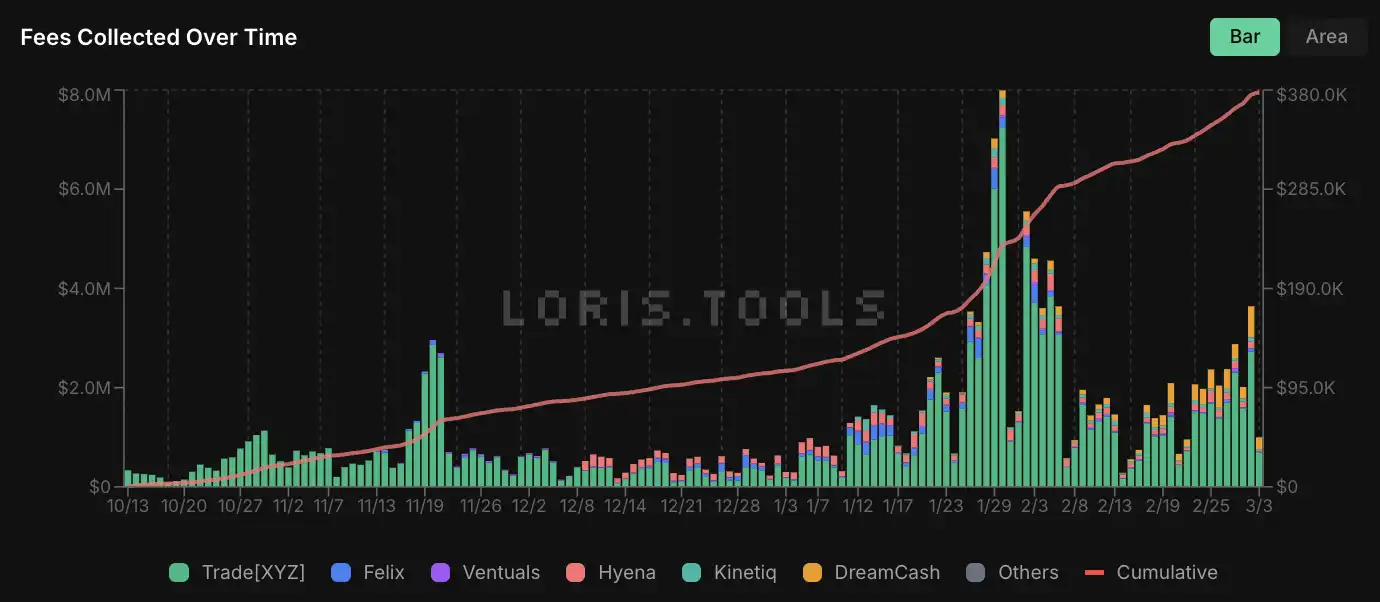
HYPE holders are not only betting on Hyperliquid's growth as an offshore Perp DEX but also on longing geopolitical uncertainty.
Hyperliquid is just the clearest expression of this narrative so far, and the market is finally starting to reflect that.
Discrepancy
Nevertheless, on-chain derivatives still have a ways to go to meet traditional institutional standards.
Hyperliquid's current edge lies in small to medium-sized retail orders. According to Blockworks Research, during normal trading hours, its Silver contract's spread is comparable to the COMEX micro contract. However, the depth discrepancy is significant. COMEX has a $13 million order book depth within ±5 bps, whereas Hyperliquid has only around $230k.
COMEX vs. Hyperliquid Order Book Depth Comparison
Source: Blockworks Research
In extreme market sell-offs, on-chain liquidity suffers from greater tail risks. 1% of Hyperliquid's Silver trades experience a slippage of over 50 bps, while COMEX still offers better execution costs in such scenarios.
COMEX vs. Hyperliquid Execution Slippage Comparison
Source: Blockworks Research
Currently, Hyperliquid's liquidity and funding rate model cannot yet meet the needs of large funds. To compete at an institutional level, on-chain platforms need to address KYC issues and may even need to establish technical and collaborative frameworks that match traditional clearing institutions. Many industry participants still believe that if the Chicago Mercantile Exchange (CME) were to launch 24/7 trading, it would have a natural hedging advantage and trust foundation.
However, the traditional financial market's reliance on a risk control model based on physical closure times has indeed shown its limitations. The ability to continuously price risk without waiting for Monday's opening is a core value proposition of offshore exchanges like Hyperliquid.
The transfer of market pricing power to the blockchain will be a long process. But we must dare to dream — just in case it comes true.
You may also like

From Pump.fun to Collector Crypt: Has Solana's income throne changed hands?
Looking at Stripe's ambitions and the future of stablecoins from OUSD
Do you want to buy CRCL?
Wosh: Inflation has cooled in recent weeks, AI is reshaping the economy, and forward guidance has lost its necessity
The most secretive AI winner
Former ByteDance employee's account: How I started with two Pinduoduo hard drives and made six times the profit with Seagate to achieve financial freedom?
MiCA reshuffle begins, Binance temporarily bids farewell to the EU
How does Gate redo "buying and selling stocks" from the cryptocurrency world to the stock market?
Visa and Mastercard join 140 giants to launch a new stablecoin, but the impact on the market landscape may still be limited
Circle CEO responds to OUSD's challenge: Stablecoins are a winner-takes-all business, and we will not slow down
Argentina vs Cape Verde: When a Record-Breaking Legend Meets an Unbreakable Underdog
WEEX exclusive pre-match analysis of Argentina vs Cape Verde, exploring Messi-led Argentina’s dominance and Cape Verde’s historic defensive breakout, with a breakdown of volatility, structure, and match dynamics.
WEEX Launches Depth Chart for Spot Trading
Raising interest rates to protect STRC and selling coins to maintain credit, this time the strategy has chosen the two most expensive paths
Morning Report | Samsung announces a 265.5 trillion won investment plan, focusing on semiconductor and AI computing power data centers; Vitalik publishes an article detailing the entire technology tree behind the confusion protocol (iO) mainline
In the era of AI, what is left of Bitcoin?
NeoSoul announced plans to integrate with the OKX Agentic Wallet, promoting AI agents' participation in the on-chain economy
Why Is Bitcoin Lagging Stocks in 2026? AI Stocks, ETF Outflows, and the Nasdaq Rally Explained
What you bought on CEX is really not US stocks: Analyzing the 94% liquidation monopoly and the evaporation of equity under a five-layer pipeline
From Pump.fun to Collector Crypt: Has Solana's income throne changed hands?
Looking at Stripe's ambitions and the future of stablecoins from OUSD
Do you want to buy CRCL?
Wosh: Inflation has cooled in recent weeks, AI is reshaping the economy, and forward guidance has lost its necessity
The most secretive AI winner
Former ByteDance employee's account: How I started with two Pinduoduo hard drives and made six times the profit with Seagate to achieve financial freedom?