
Bitcoin V-Shaped Reversal, CME Gap Could Be the Biggest "Risk"

Original Article Title: "After Bitcoin's V-Shaped Reversal, Could the CME Gap Be the Biggest 'Hidden Danger'?"
Original Source: BitpushNews
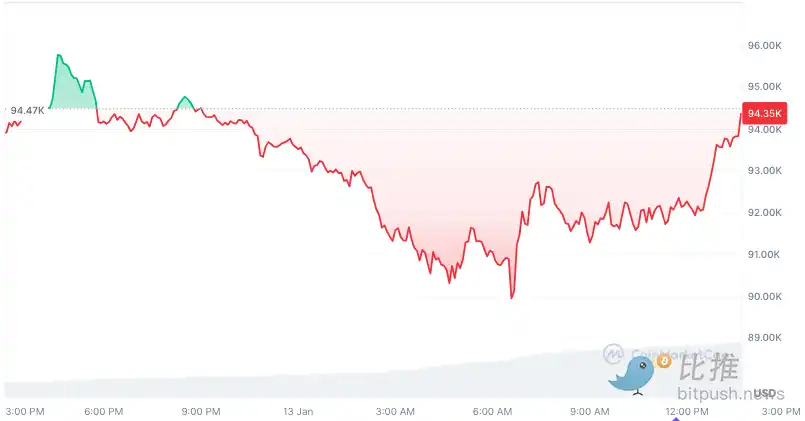
Over the past 24 hours, Bitcoin has staged a V-shaped reversal drama, hitting a low of $90,000, an eight-week low, and bouncing back above $94,000 after the U.S. stock market close, with the market's longs and shorts in a tense situation. Bitcoin's price has dropped over 7% in the past week. Although its market cap continues to hover around $1.864 trillion, its dominance has slightly decreased to 54.2%.
Macroeconomic Factors Lead to Temporary Market Cooling
Experts believe that the pullback that began last week is attributed to optimistic U.S. economic data, including better-than-expected initial jobless claims and labor participation rate. This data has heightened concerns that interest rates may remain high for a longer period than expected.
Chris Chung, CEO and Founder of Titan, stated: "The market seems very concerned that there won't be any more rate cuts in 2025, especially given the incredibly strong jobs report released on Friday. But we also saw a big rally in December, so it's not uncommon for the market to readjust after such a large rally."
He pointed out that with U.S. President-elect Donald Trump set to be inaugurated next week, there is still "further downside risk" in the cryptocurrency market.
Chris Chung said: "Everyone expects Trump to announce regulatory support for cryptocurrency on day one, but he may start with more pressing issues given the Republican control of the House and Senate, along with macro concerns and upcoming token unlocks, this market adjustment may continue into February or even March."
James Butterfill, Head of Research at CoinShares, stated in his fund report: "The honeymoon period after the U.S. election is over, and macroeconomic data once again becomes a key driver of asset prices."
Derivatives Data Shows Sentiment Ranges from Mildly Bullish to Neutral
It is worth noting that the reaction in the Bitcoin derivatives market has been relatively mild.
Firstly, the futures premium is high, as Bitcoin futures contracts typically trade at a premium to the spot market, reflecting market optimism about future prices. Data shows that the current annualized premium rate is at 11%, above the 5%-10% neutral range, indicating that market participants overall remain optimistic.
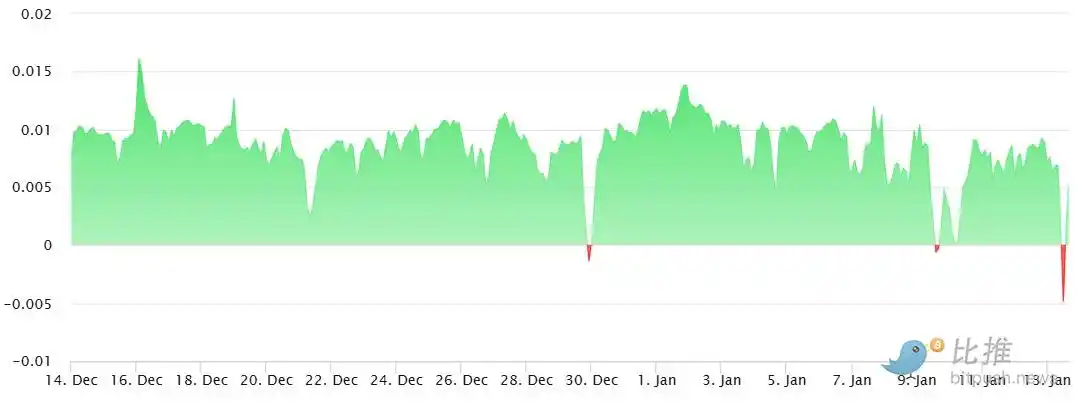
Another indicator is the perpetual contract funding rate (usually reflecting market sentiment). Although on January 13, due to a large number of short positions entering the market, the funding rate briefly turned negative, accompanied by $1.07 billion in long liquidations. However, it quickly rebounded to around 0.5% monthly rate, showing that the market did not exhibit sustained bearish sentiment.
CME Gap Pressure, Will It Be Filled?
Analysts say there is a gap between $88,500 and $77,500 on the CME chart. When there is a difference in the Bitcoin futures price between the close of one trading day and the open of the next trading day, a CME gap occurs, which usually causes Bitcoin to tend to return to a certain level. If Bitcoin faces a downward correction, this gap represents a potential bearish target.
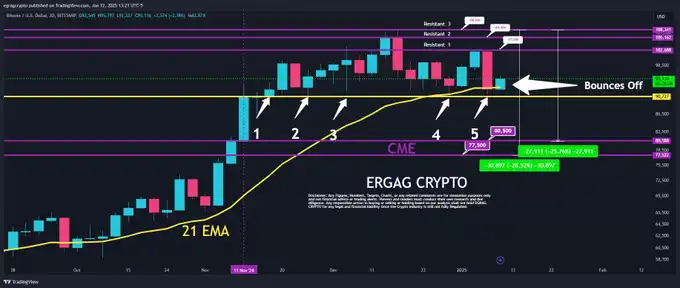
Analysts believe that given Bitcoin's current price of around $94,000, a drop from this level could lead to a significant pullback, potentially resulting in a decline of up to 18% to fill this CME gap.
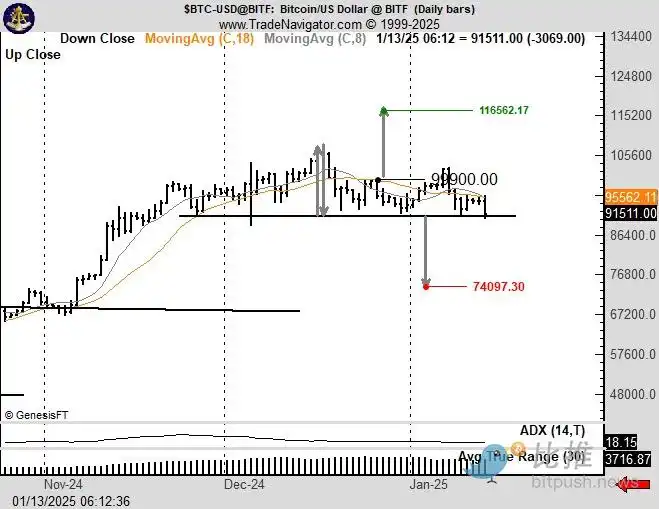
In addition to the CME gap, veteran market analysts like Peter Brandt also point out a potential bearish signal on the Bitcoin daily chart. Brandt suggests that a head and shoulders pattern could form, which may indicate that the Bitcoin price could fall to $73,000. However, Brandt also warns against relying too heavily on this chart as BTC's high volatility often leads to changes in chart patterns.
Therefore, Bitcoin's current trend is influenced by multiple complex factors. While the derivatives market remains relatively calm, the presence of the CME futures market gap, a potential head and shoulders pattern, and key support levels increase the risk of a price downturn. If Bitcoin continues to face pressure, the market will closely monitor whether it will fill the CME gap, which could trigger significant market volatility.
You may also like

Morning News | Michael Saylor stated that this week he bought bonds instead of Bitcoin; StablR was attacked and lost about 2.8 million dollars; the U.S. Congress is pushing the Bitcoin Reserve Act again

SuperEx's Mars exploration dream: Digital currency is the key to unlocking economic exchanges in the interstellar era

Key Takeaways: Full Text of Google Chief Scientist Shanahan's Speech

Agentic Design Patterns: A book that made me rethink "What exactly is an Agent?"

The richest chairman of the Federal Reserve in 112 years has arrived: Kevin Warsh is rewriting the rules

Vitalik talks about the future of the Ethereum Foundation: a smaller, more distinctive, yet more enduring ship

New Types of Information Laundering in Prediction Markets: How Secrets Integrate into Investment Signals

Vitalik emphasized in a post that Ethereum must be "amazing," but the foundation is not the center

DeFi has reached its most dangerous moment: the real vulnerabilities are not in the code

WEEX Bitcoin Pizza Day: Zero Fees, BTC Cashback & 150,000 USDT to Honor Crypto History

a16z: 7 Images to Understand How Tokenization Changes the Nature of Assets

The secret to Hyperliquid's success dismantled from the five-layer financial stack
After Futu Securities was banned, will buying stocks on-chain be the new remedy?

Why Crypto Traders Are Watching Gold and Nasdaq Again in 2026
Why have foreign exchange stablecoins never taken off?

AIDC, computing power leasing, and cloud: The "three-part thesis" of AI transformation in cryptocurrency mining farms

Futu has had all its illegal gains confiscated, reminding cryptocurrency exchanges

Football, Web3 & Champions' Energy: A Recap of WEEX's LALIGA VIP Meetup in Barcelona
Morning News | Michael Saylor stated that this week he bought bonds instead of Bitcoin; StablR was attacked and lost about 2.8 million dollars; the U.S. Congress is pushing the Bitcoin Reserve Act again
SuperEx's Mars exploration dream: Digital currency is the key to unlocking economic exchanges in the interstellar era
Key Takeaways: Full Text of Google Chief Scientist Shanahan's Speech
Agentic Design Patterns: A book that made me rethink "What exactly is an Agent?"
The richest chairman of the Federal Reserve in 112 years has arrived: Kevin Warsh is rewriting the rules
Vitalik talks about the future of the Ethereum Foundation: a smaller, more distinctive, yet more enduring ship