
Bitcoin continues to plummet, will Strategy be forced to sell?


Original Title: "Bitcoin Continues Sharp Decline, MSTR Forced to Sell Becomes Focus"
Original Author: Ye Zhen, Wall Street See News
Bitcoin is undergoing a severe stress test against institutional holdings, as the price falls below a key psychological level, approaching the cost basis of major holders like MicroStrategy, the market's concern over high-leverage holders' liquidity is rapidly escalating.
Over the weekend, Bitcoin broke below the $80,000 integer mark, hitting its lowest level since April 7, 2025. This round of selling occurred against the backdrop of significant market illiquidity, further intensifying Bitcoin's recent cumulative decline of over 30%.
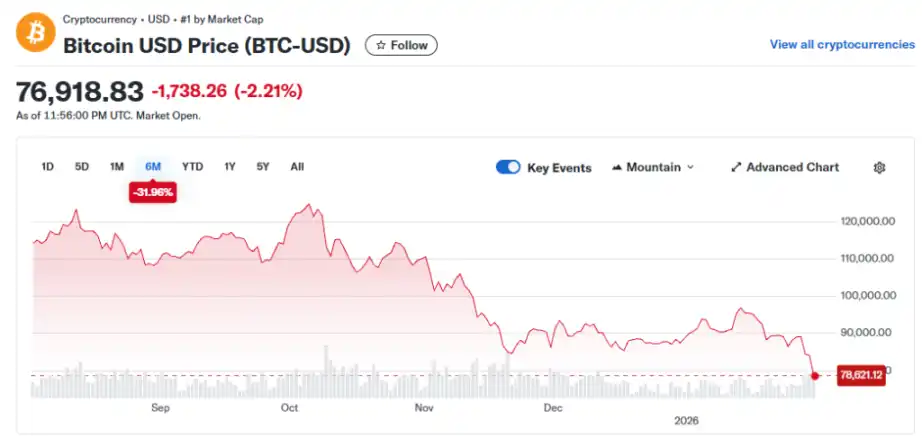
Despite the gloomy market sentiment, MicroStrategy CEO Michael Saylor posted an image with the caption "More Orange" on social media platform X on Sunday, implying continued buying. The company announced a 25 basis point increase in the dividend on its Series A Perpetual Preferred Stock (STRC) to 11.25%, aiming to attract capital at a high financing cost to maintain its Bitcoin purchase strategy. However, analysts point out that if the coin price remains stagnant or falls below its cost basis, the high dividend payout may trigger severe cash flow constraints.

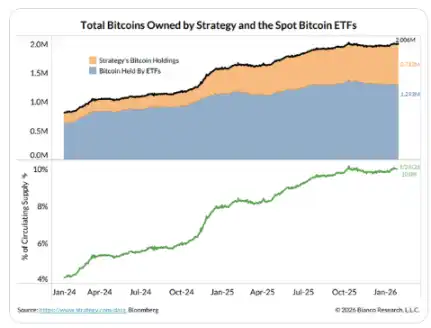
Bianco Research's Macro Strategist Jim Bianco's analysis indicates that the Bitcoin market is facing a narrative exhaustion crisis. The current market structure exhibits a highly institutionalized feature, with ETF investors and MicroStrategy collectively controlling about 10% of the float, and currently overall underwater. This suggests that the once supportive "institutional entrance" narrative may flip into a significant source of selling pressure after being trapped at the peak.
Institutional Holding Underwater Intensifies, ETFs Experience Net Outflows
Jim Bianco's analysis shows that Bitcoin is becoming highly "institutional accountized," meaning the market can now clearly observe large funds' holding costs and P/L status. Currently, MicroStrategy and 11 physical Bitcoin ETFs collectively hold about 10% of Bitcoin's float, with their combined average purchase cost at around $85,360. Based on the current price, these institutional holdings are collectively underwater by about $8,000 per coin, with a total unrealized loss of approximately $7 billion.
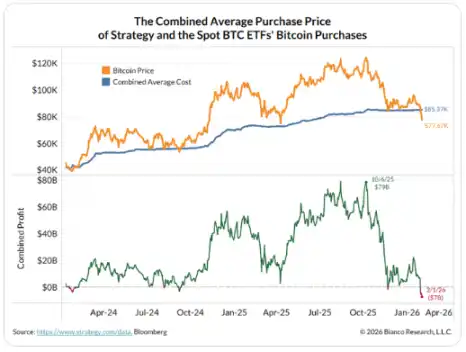
Among them, spot ETFs have become a core force influencing the supply-demand structure. Data shows that the 11 largest spot Bitcoin ETFs hold 1.29 million Bitcoins, accounting for 6.5% of the circulating supply, with a market value of approximately $115 billion. However, the average buy-in cost of these ETF investors is as high as $90,200, and the current coin price is about $13,000 lower than their cost.
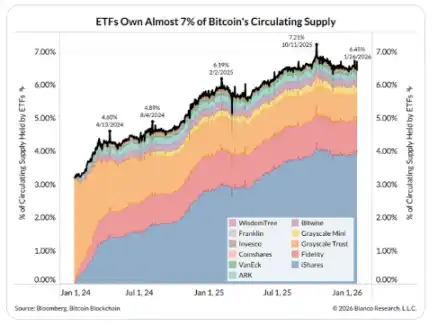
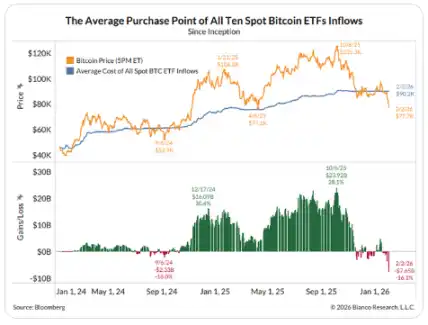
This high-level bottom fishing structure has led to a typical pro-cyclical effect. Bianco pointed out that these ETFs have seen net outflows for 10 consecutive trading days, with investors choosing to redeem during the retracement after buying in at a high level, amplifying the market's downward volatility.
MicroStrategy Safety Net Narrows, Aggressive Financing Raises Concerns
As the benchmark for corporate Bitcoin holdings, MicroStrategy's balance sheet is facing its most severe test in months. Currently, the company holds 712,647 Bitcoins with an average cost of around $76,037. With the Bitcoin trading price falling to around $78,000, the company's unrealized gains have narrowed significantly to less than 3%.
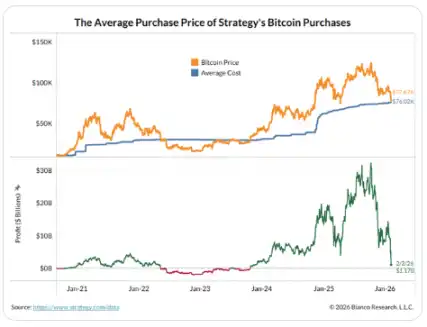
Despite the narrowing safety net, MicroStrategy has not shown signs of backing down. To fund the next phase of purchases, the company has adjusted the yield on its STRC product to 11.25%. This rate of return carries a significant premium compared to typical corporate bonds, reflecting the company's extreme capital thirst and the inherent volatility risk of its Bitcoin-centric model. Data shows that since the debut of the STRC product in November, sales of this product alone have funded the purchase of over 27,000 Bitcoins.
Analysis believes that MicroStrategy is still profitable, but its margin of error has significantly diminished. If the price continues to fall, the company will face an overall unrealized loss. Maintaining dividends at such a high cost could lead to cash flow constraints, especially when the Bitcoin price falls below its $76,000 cost "watermark," making this risk particularly acute.
Old Narrative Obsolete, Market in Urgent Need of New Catalysts
From a macro perspective, this recent plunge has intensified the market's disappointment of recent weeks. Jim Bianco believes that the real issue facing Bitcoin is the lack of a new narrative. The previously highly anticipated "Boomer Adoption" story, which the market had pinned its hopes on, has now been fully priced in and is even being debunked.
The current market structure shows that ETFs and MicroStrategy not only bought heavily and in a concentrated manner, but are currently overall underwater. Bianco points out that as long as a new, sustainable buying narrative does not emerge, the trend of outflows is likely to continue. In this scenario, what was once seen as a bullish high-level institutional holding may instead become the market's biggest source of pressure. The current issue with Bitcoin is not whether people bought in the past, but rather, at the current price level, where the next batch of buyers will come from.
You may also like

$10,000 in TRUMP Token vs. $10,000 in Nasdaq: The "Trump Trade" That Actually Worked in 2026
Morning Report | Vitalik outlines Ethereum's long-term roadmap, Lean Ethereum will become the third major iteration; SK Hynix seeks to attract more AI investors by listing in the U.S
The impact of OUSD on Circle, Tether, and Paxos: not a single negative factor, but a more complex reshaping of competition
Li Feifei's latest long article: When video generation, robots, and NVIDIA all claim to be world models, we need a taxonomy
Blaming the desolation of the cryptocurrency world on the rise of AI is a form of intellectual laziness
Strategy Founder: The Next 10 Years of Bitcoin
Forbes Special Report: Stablecoin cross-border payments are faster now, but not cheaper yet
A valuation of 8 billion dollars, doubling in 8 months! What makes the crypto-friendly bank Erebor Bank stand out?
340 billion valuation: Li Yanhong's largest IPO, a seat in Kunlunxin's shares is hard to come by
Stablecoins are the "royalists" of the crypto world: Open USD brings the old currency system into play
Cape Verde 2-3 Argentina: The Underdog Team That Stunned the World in Defeat
Cape Verde's run ended in a 3-2 defeat to Argentina, but their journey — three unbeaten draws, one heroic goalkeeper, and a fight that pushed the defending champions to the brink — is the kind of story markets recognize too: small caps can rattle blue chips long before anyone expects it.
Semiconductor stocks plummet, yet Anthropic wants to create a 2nm chip
Where is Zhao Changpeng's billion-dollar investment going? YZi Labs' investment landscape fully revealed
Ethereum Foundation Report: A Basic Guide to Ethereum for Governments and Financial Institutions
A pre-announced harvesting case: After the cryptocurrency price dropped by 99%, the public chain Saga exited to transform into AI
When American giants collectively "defect" from Chinese AI models
BIS Report Compliance Observation: The Real Risks of Stablecoins, Not Just "Depegging"
Portugal 2-1 Croatia: Ronaldo's 20-Year Knockout-Stage Drought Ends With a Debt Finally Collected
Portugal beat Croatia 2-1 in the 2026 global football championship's knockout rounds as Ronaldo scored his first-ever knockout-stage goal, Gonçalo Ramos struck a stoppage-time winner, and VAR ruled out a late equalizer for offside.
$10,000 in TRUMP Token vs. $10,000 in Nasdaq: The "Trump Trade" That Actually Worked in 2026
Morning Report | Vitalik outlines Ethereum's long-term roadmap, Lean Ethereum will become the third major iteration; SK Hynix seeks to attract more AI investors by listing in the U.S
The impact of OUSD on Circle, Tether, and Paxos: not a single negative factor, but a more complex reshaping of competition
Li Feifei's latest long article: When video generation, robots, and NVIDIA all claim to be world models, we need a taxonomy
Blaming the desolation of the cryptocurrency world on the rise of AI is a form of intellectual laziness
Strategy Founder: The Next 10 Years of Bitcoin