
Polymarket vs Kalshi: The Future of Prediction Markets Explained

Prediction markets have become one of the most discussed sectors across crypto, quantitative trading, and financial technology. Platforms like Polymarket and Kalshi are transforming future events into tradable markets where users can express views through probability-based contracts.
But the rise of prediction markets also creates a major question: are they financial innovation, gambling products, or something entirely new?
This article compares Polymarket vs Kalshi, explains how prediction markets work, explores regulatory challenges, and analyzes why this sector may become an important part of the future information economy.
KEY TAKEAWAYS
- Prediction markets are evolving from niche event-betting platforms into information-driven financial infrastructure.
- Polymarket and Kalshi represent two different paths: decentralized Web3 prediction markets versus regulated event contract exchanges.
- The biggest debate around prediction markets is not only whether they are gambling, but whether they should be treated as financial products.
- AI, blockchain infrastructure, and increasing demand for probability-based information are accelerating prediction market adoption.
- Future opportunities may come from data tools, analytics platforms, and market infrastructure, while execution and custody services face higher regulatory risks.
What Are Prediction Markets?
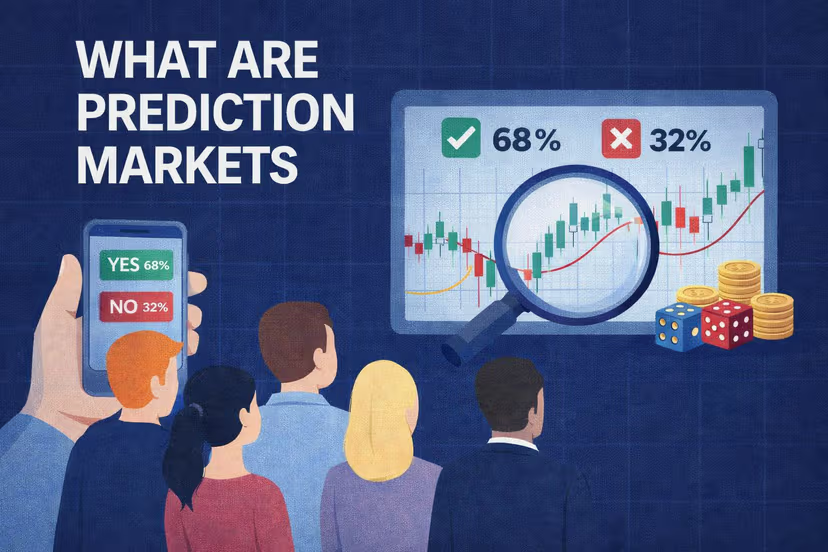
Prediction markets allow users to trade contracts based on whether a future event happens.
Unlike traditional financial markets, where traders speculate on asset prices, prediction markets focus on event outcomes.
Examples include:
- Will a central bank change interest rates?
- Will a candidate win an election?
- Will a company achieve a specific milestone?
A typical prediction market uses binary contracts:
| Contract | Outcome |
|---|---|
| YES | Pays if the event happens |
| NO | Pays if the event does not happen |
If a YES contract trades at $0.70, the market is roughly suggesting a 70% probability that the event will occur.
This creates a system where market prices represent collective expectations rather than only individual opinions.
Polymarket Explained: The Web3 Prediction Market Model
Polymarket represents the decentralized prediction market approach.
Instead of operating like a traditional financial exchange, Polymarket uses blockchain infrastructure to create event-based markets.
Its model focuses on:
- Crypto-based settlement
- Global user access
- Transparent market activity
- Blockchain-based records
Polymarket became one of the most recognized Web3 prediction platforms because it made event trading easier for crypto-native users.
However, its regulatory journey has been complex.
In 2022, the U.S. Commodity Futures Trading Commission (CFTC) announced a $1.4 million settlement with Polymarket for operating an unregistered event-based binary options market.
After that, Polymarket restricted U.S. users and continued developing its platform internationally.
The case highlights a central challenge for decentralized prediction markets: blockchain technology can change infrastructure, but regulatory classification still depends on what service is being provided.
Kalshi Explained: The Regulated Prediction Market Approach
Kalshi follows a very different strategy.
Rather than operating as a decentralized Web3 platform, Kalshi chose the regulated financial market path.
Kalshi received approval from the CFTC as a Designated Contract Market (DCM), allowing it to offer certain event contracts under U.S. federal oversight.
This makes Kalshi closer to traditional financial infrastructure.
Its advantages include:
- Clearer regulatory positioning
- Institutional compatibility
- Defined compliance framework
However, regulation also creates limitations.
A regulated exchange may face stricter rules on:
- What events can be listed
- User requirements
- Product expansion speed
The comparison between Polymarket and Kalshi reflects a larger question: should prediction markets grow like open internet platforms or regulated financial exchanges?
Polymarket vs Kalshi: Key Differences
Although both platforms focus on event-based markets, their strategies are very different.
| Category | Polymarket | Kalshi |
|---|---|---|
| Market Type | Web3 prediction market | Regulated event exchange |
| Infrastructure | Blockchain-based | Traditional regulated framework |
| Regulatory Strategy | Global crypto model | CFTC-supervised model |
| User Experience | Crypto-native | Finance-native |
| Growth Focus | Open market participation | Compliance-first expansion |
Neither model is guaranteed to dominate.
The future prediction market industry may include both decentralized platforms and regulated exchanges serving different user groups.
Why Prediction Markets Are Growing Fast
Prediction markets gained attention because they solve a simple problem: people want better ways to measure uncertainty.
Traditional information sources often rely on:
- Expert opinions
- Surveys
- Media narratives
Prediction markets introduce financial incentives.
When participants risk capital, their information and beliefs become reflected in prices.
This creates what many researchers call an information aggregation mechanism.
Instead of asking “what do people say will happen?” prediction markets ask:
“What probability are people willing to trade at?”
That difference is why prediction markets attract attention from traders, researchers, and technology builders.
AI and Prediction Markets: A Natural Combination?
Artificial intelligence is becoming an important part of the prediction market discussion.
AI models are strong at:
- Processing large amounts of information
- Summarizing complex events
- Comparing different scenarios
Prediction markets provide something AI does not naturally have: a live price signal backed by economic incentives.
The combination could create new tools such as:
- AI-powered event analysis
- Probability dashboards
- Market sentiment tracking
- Data aggregation platforms
However, there is an important distinction.
Using AI to organize information is different from using AI to automatically execute trades.
The second area may create additional regulatory questions.
Prediction Market Startup Opportunities and Risks
As prediction markets grow, new business opportunities are appearing around the ecosystem.
The safest areas are usually closer to information infrastructure.
Data and Analytics Tools
These platforms organize market information without handling user funds.
Examples include:
- Market dashboards
- Probability tracking
- Event databases
- Research tools
These services usually resemble data providers rather than financial platforms.
Strategy and Signal Products
Tools that identify price differences, market trends, or possible arbitrage opportunities have strong demand.
The key question is control.
Providing information is very different from executing trades for users.
Trading and Execution Services
Features such as automated trading, copy trading, or managed strategies enter a more sensitive area.
Regulators may evaluate whether these services resemble:
- Investment advice
- Brokerage activity
- Asset management
This boundary is especially important in prediction markets because regulatory definitions are still developing.
The Biggest Regulatory Challenges Ahead
Prediction markets exist between several categories:
- Financial products
- Information markets
- Gaming systems
- Technology platforms
Different countries may classify the same product differently.
The most important regulatory questions include:
Does the platform control user funds?
Does it execute trades for users?
Does it provide financial recommendations?
Does it create additional consumer risk?
The answer to these questions often matters more than how a company describes itself.
Final Thoughts: Are Prediction Markets the Future?
The future of prediction markets is unlikely to follow only one path.
Kalshi shows how event contracts can develop inside regulated financial systems.
Polymarket shows how blockchain technology can create global, transparent probability markets.
The long-term value of prediction markets may not come from simply predicting winners and losers. Their bigger role may be creating a new information layer where uncertainty itself becomes measurable.
For users exploring broader crypto ecosystems, resources such as WEEX Token (WXT) information and the WEEX welcome bonus can help users understand exchange features, token ecosystems, and available platform incentives.
FAQ
1. What is the difference between Polymarket and Kalshi?
Polymarket is a blockchain-based prediction market platform, while Kalshi operates through a regulated event contract exchange model under CFTC oversight. They represent two different approaches to building prediction market infrastructure.
2. Are prediction markets considered gambling?
The classification depends on local regulations. Some jurisdictions treat prediction markets as financial products, while others may classify certain event markets closer to gambling.
3. Why are prediction markets becoming popular?
Prediction markets are growing because they create real-time probability signals based on user participation. They provide an alternative way to measure expectations around uncertain future events.
4. How does AI connect with prediction markets?
AI can help analyze information, summarize events, and compare market signals. Prediction markets provide probability data that can complement AI-generated insights.
5. Will prediction markets become mainstream financial products?
The future depends on regulation, user adoption, and market infrastructure. Both regulated platforms like Kalshi and Web3 models like Polymarket may continue developing in different directions.
Disclaimer: This content is provided for general informational and educational purposes only and should not be considered financial, investment, legal, or tax advice. Nothing in this article constitutes an offer, recommendation, solicitation, or invitation to buy, sell, or trade any crypto asset or use any specific service. Crypto assets are highly volatile and involve a high degree of risk. You may lose some or all of the value of your investment and should not invest funds you cannot afford to lose. WEEX services may not be available in all regions and are subject to applicable laws, regulations, and user eligibility requirements. Please carefully assess risks and confirm local requirements before making any financial decisions.
You may also like
Top 4 Altcoins to Buy in July 2026: Top Crypto Picks for Investors
Who Is Jensen Huang? Nvidia CEO's Net Worth, Biography & NVDA Stock Analysis 2026. Is NVDA Stock a Good Buy Right Now?
Prediction Market Regulation: Polymarket, Kalshi and Future Trends
Polymarket vs Kalshi: The Future of Prediction Markets Explained
Prediction Market Arbitrage Explained: How Traders Find Profits
How Polymarket Market Making Works: Risks and Profit Strategies
What Is a Prediction Market? Complete 2026 Guide to Polymarket, Kalshi & Crypto Betting Platforms
Nvidia vs Microsoft Stock 2026: Which AI Giant Is the Better Buy in July?
MicroStrategy's STRC Unpegged: Buy the Dip or Brace for Impact?
How to Buy Cryptocurrency on WEEX Exchange 2026: Full Guide
Prediction Market Apps 2026: How Prediction Markets Work? Are They Safe and Legal?
Is Polymarket Legal in India in 2026? Key Legal Updates on Prediction Markets
14 Best Prediction Market Apps in 2026: The Ultimate Guide to Crypto-Native and Regulated Platforms
Can Politicians Rig Election Prediction Markets? The Dark Side of Election Prediction Markets
2026 US Election Odds: Who Leads Right Now on Polymarket and Kalshi?
What Is a Crypto Prediction Market? Key Opportunities in the Prediction Market Sector
Plot twist in the AI race—the next big flex is actually physical infra?
How to Profit on Prediction Market: A Beginner's Guide to Prediction Market
Top 4 Altcoins to Buy in July 2026: Top Crypto Picks for Investors
Who Is Jensen Huang? Nvidia CEO's Net Worth, Biography & NVDA Stock Analysis 2026. Is NVDA Stock a Good Buy Right Now?
Prediction Market Regulation: Polymarket, Kalshi and Future Trends
Polymarket vs Kalshi: The Future of Prediction Markets Explained
Prediction Market Arbitrage Explained: How Traders Find Profits
How Polymarket Market Making Works: Risks and Profit Strategies
Contents
Popular coins


